
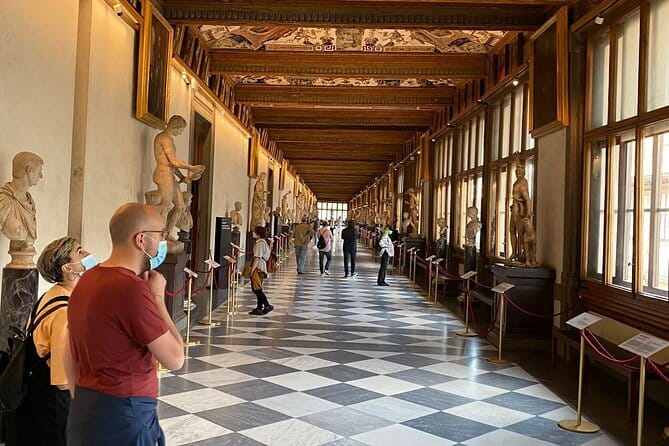
Reviewed · UFFIZI & ACCADEMIA GALLERY TOURS
Uffizi and Accademia Small Group Guided Tour
Florence’s greatest hits fit into one focused morning. I like this tour because it pairs the Uffizi’s Renaissance masterpieces with Michelangelo’s David, and because an authorized guide adds the stories and symbols that are easy to miss on your own. I also like the small-group limit of 15, though the schedule can feel rushed, especially at the Uffizi and during the walk to the Accademia.
This is a strong choice if you have only a short time in Florence and want help finding the major works. Guides such as Mariela, Francesco, Pamela, Rosa, Marta, Lara, Silvia, and Laura have been praised for their art knowledge, clear storytelling, and ability to move groups through crowded rooms. The main caution is simple: this is a highlights tour, not a quiet afternoon with each painting.
In This Review
- Key points to know before booking
- Why this Florence pairing works so well
- Starting at the Uffizi with Botticelli and Caravaggio
- The 15-minute walk adds a little Florence
- Meeting Michelangelo’s David at the Accademia
- What the guides add to the visit
- Timing, crowds, and the real meaning of priority entry
- Who will get the most from this tour
- Practical details that affect your decision
- Should you book the Uffizi and Accademia tour?
- FAQ
- How long does the Uffizi and Accademia tour last?
- What museums are included?
- Is admission included in the price?
- Is the tour offered in English?
- How large is the group?
- Where does the tour start?
- Where does the tour end?
- Do I need to bring identification?
- Can I cancel for a refund?
Key points to know before booking
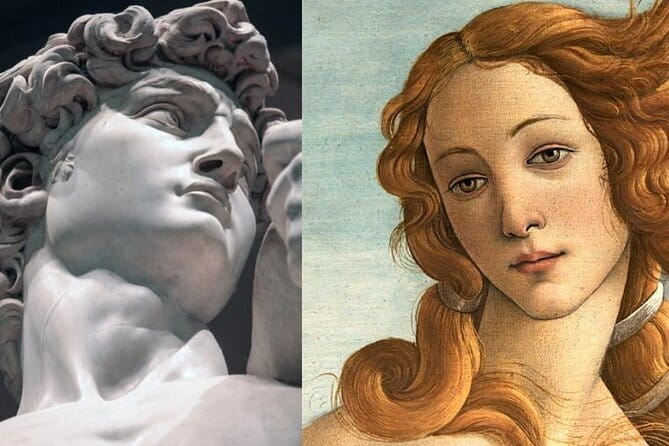
- Two essential Florence museums in about three hours: You visit the Uffizi and Accademia in one compact outing, with the tour ending at the Accademia.
- Michelangelo’s David is the emotional high point: The guide places the statue in its artistic and civic setting, rather than treating it as a quick photo stop.
- The Uffizi route focuses on famous works: Expect Botticelli’s Birth of Venus and Spring, Caravaggio’s Medusa, and Michelangelo’s Tondo Doni.
- The group is capped at 15 people: Groups of more than four use earphone radios, which helps you hear the guide in busy galleries.
- Priority access helps, but does not guarantee instant entry: A wait at the Uffizi has occurred even with prepaid admission.
- Bring matching identification: Every person entering the Uffizi must show a valid passport or ID matching the reservation details.
Why this Florence pairing works so well
The Uffizi and Accademia show two different sides of Florence. The Uffizi gives you painting, patronage, religion, and the rise of the Italian Renaissance. The Accademia is more concentrated, with sculpture at its center and Michelangelo’s David as the main event.
Doing both in one tour gives you a useful artistic arc. You begin with the long development of European painting, then move into the power and physical drama of Renaissance sculpture. I especially like that the experience does not treat David as an isolated celebrity. The Accademia visit also includes other Michelangelo works, musical instruments, golden-background paintings, and the Sala dei Prigioni.
The format suits you if you want the big picture without spending half a day planning museum routes. A guide points out the works worth your limited time and explains why they matter. The tradeoff is that you give up some freedom to linger.
The tour is offered in English and costs $151.16 per person. That is a serious price, but it includes the authorized guide, booking fee, admission to the museums as described, and a €29 Uffizi ticket. You are also paying for the planning and timed coordination between two busy museums.
I see the price as reasonable for a first visit if art history is not your strong suit or if avoiding ticket research matters to you. It is less appealing if you prefer an audio guide, a slow pace, or the cheapest possible entry. Direct museum tickets may cost less, but you will need to manage the route and explanations yourself.
More Uffizi and Accademia tickets:
- Florence: Skip-The-Line Uffizi Gallery Timed Entry Ticket
★ 4.5 · 27,832 reviews - Florence: Uffizi Priority Ticket & Masterpieces Audio App
★ 4.2 · 6,402 reviews - Florence Accademia Gallery Tour with Entrance Ticket Included
★ 4.5 · 6,148 reviews
Starting at the Uffizi with Botticelli and Caravaggio
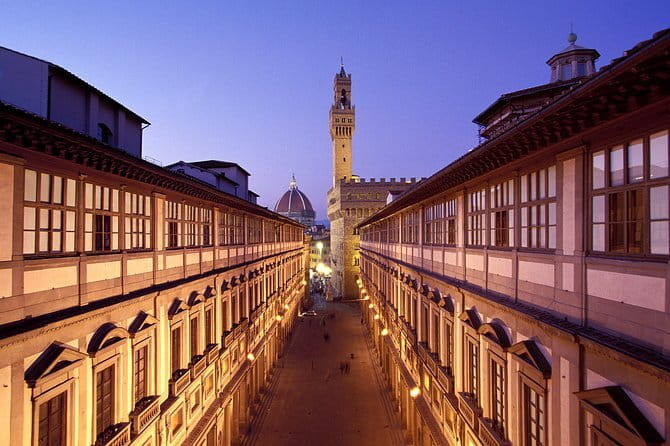
Meet at Via dei Castellani, 14, near the Uffizi. This is the starting point and ticket redemption location, so give yourself extra time to find it. One person specifically found the meeting spot challenging, and arriving at the stated time does not always mean you walk straight into the galleries.
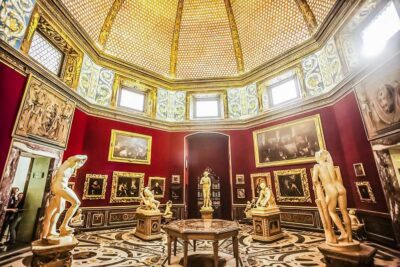
The guided Uffizi portion lasts about 1.5 hours, with the stop listed at roughly 1 hour 45 minutes including entry and individual time. The route moves through art from the Middle Ages into the Italian Renaissance, with attention on the museum’s best-known works.
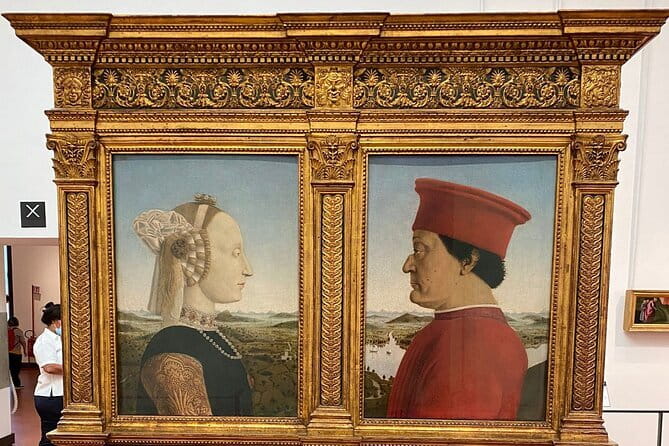
Botticelli’s Birth of Venus and Spring are central stops. A good guide can help you look past their fame and notice the mythological themes, graceful figures, and details that make these paintings more than familiar textbook images.
Caravaggio’s Medusa gives the visit a sharper edge. Michelangelo’s Tondo Doni adds another important point of comparison, since the tour lets you consider Michelangelo as a painter as well as a sculptor. The description identifies it as the only painting he made on wood, a detail worth keeping in mind as you view it.
The Uffizi is much larger than the Accademia, and that difference shapes the whole experience. You will not see everything. The guide selects major pieces and gives you a working map of the collection, which is useful when time is short but frustrating if you already have a long list of paintings you want to study.
This is where the strongest criticism applies. Some tours have moved quickly, with only brief stops at the major works. One person felt the guide spent too much time asking the group questions instead of giving concise explanations. Another described the visit as a quick pass through the highlights.
I would approach the Uffizi with a clear goal: listen closely, see the major works, and accept that this is not the right tour for prolonged contemplation. If one painting matters greatly to you, tell the guide early if time allows. The guide may also help you find a better viewing position, a skill praised in several accounts.
The Uffizi section includes some personal time, and the stated arrangement says you may continue exploring at your leisure. Still, the next museum is scheduled, and the walk to the Accademia takes about 15 minutes. Do not assume you can spend an hour wandering through side rooms without affecting the rest of the plan.
The 15-minute walk adds a little Florence
The route between museums is on foot, not by private vehicle. Transportation is not included, and none is needed for this central connection.
The walk takes about 15 minutes and functions as a short introduction to the city between museum visits. One guide used the route to add an abridged walking tour and gave food suggestions for the area. That extra city context can make the experience feel less like two sealed museum visits.
The walk also creates pressure. If the Uffizi visit starts late or entry takes longer than expected, the Accademia schedule can suffer. One particularly unhappy participant arrived at the second museum about 20 minutes late and decided to skip that portion. The guide or operator may not release the Accademia tickets for separate use later, so you should treat the two-part schedule as fixed.
Meeting Michelangelo’s David at the Accademia
The Accademia visit lasts about an hour, with the stop listed at approximately 1 hour 15 minutes. You enter through a priority entrance and follow the guide to David, the museum’s main attraction and one of Florence’s defining symbols.
The statue is made from marble and measures 520 centimeters in height. Michelangelo worked on it from 1501 to the beginning of 1504. Those dates and dimensions help explain the scale of the achievement, but the guide’s interpretation is what turns the stop into more than a look at a famous statue.
The best accounts praise guides for explaining the history and meaning behind David. One guide had the group move around the room to show how the sculpture changes with your point of view. That is a valuable lesson here: David is not simply a front-facing image. The tilt of the head, the balance of the body, and the tension in the hands reward careful looking.
The Accademia contains more than David, though the statue naturally takes most of the attention. The tour also covers a large collection of Michelangelo sculptures, the museum of musical instruments, golden-background paintings, and the Sala dei Prigioni. The latter contains sculptures designed for Pope Julius II.
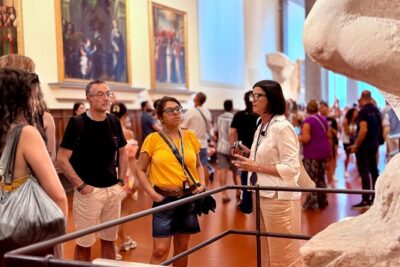
I like the Accademia portion because it is more concentrated than the Uffizi. You can build a stronger understanding of Michelangelo’s work in a shorter time. The drawback is crowding. Several accounts describe the museum as very busy, and a large group can make it harder to stay near the guide or find a comfortable viewing position.
After the guided route, you can remain inside the museum to look at additional works. That extra time is useful, but the amount of freedom depends on how the tour has run and how closely you need to follow the schedule. Ask the guide at the start how much time you should expect after the formal commentary.
A few more Florence bookings to compare
- Tuscany Day Trip from Florence: Siena, San Gimignano, Pisa and Lunch at a Winery
★ 5.0 · 21,634 reviews - Florence: Timed Entrance Ticket to Michelangelo’s David
★ 4.6 · 16,983 reviews - Florence: Michelangelo’s David Skip-the-Line Entry Ticket
★ 4.5 · 12,764 reviews - The Best tour in Florence: Renaissance & Medici Tales – guided by a STORYTELLER
★ 5.0 · 12,316 reviews
What the guides add to the visit
The guide is the main reason to choose this experience instead of buying tickets alone. The most praised guides are described as warm, funny, patient, and able to bring the art and city history to life.
Mariela was praised for being thorough without overwhelming the group. Francesco explained both art and history, then offered food suggestions. Pamela handled a group of 10 on a very busy Tuesday and answered many questions patiently. Rosa was praised for knowing how to move around crowds, while Marta received repeated praise for her history and engaging style.
Lara was described as an excellent choice for a relaxed, informative pace. Silvia made the material accessible even to someone with little art background. Laura was praised for covering the key works in a short period and explaining hidden details in the artwork.
These comments point to a pattern: the guide can make or break the outing. With a strong guide, the short schedule becomes efficient rather than stressful. With a less effective guide, the same schedule can feel disorganized and too fast.
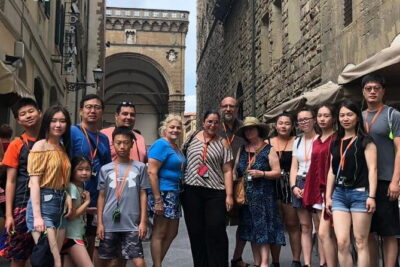
Group size matters as well. The maximum is 15, but a group of six or ten will feel different from a full group. Several people liked the smaller setting because it made moving through the museums easier. Someone else felt a larger group made it harder to ask questions and caused people to fall behind.
For groups larger than four, earphone radios are provided. That is helpful in crowded galleries, though you still need to keep an eye on the guide and remain with the group.
Timing, crowds, and the real meaning of priority entry
The word priority should not be read as instant entry. The Uffizi can still involve a ticket-office process and a wait. One account describes a 45-minute line despite prepaid admission, while another reports nearly 30 minutes before entering.
That does not make the ticket arrangement useless. During busy periods, having a reserved place and an operator coordinating entry may still save time compared with arriving without a plan. But delays can eat into the guided portion, and the schedule leaves little spare room.
The Accademia has a priority entrance, which is especially helpful when the museum is crowded. Tuesdays may be particularly busy because the museums are closed on Mondays, so consider how the day of your visit could affect the pace.
Arrive early. The stated meeting time is before the tour begins, and the meeting point can be hard to spot. Keep your voucher ready and make sure every name is entered in full. At the Uffizi, each person must show a passport or ID matching the reservation name. A mismatch can lead to refusal of entry.
Who will get the most from this tour

I would recommend this tour to you if:
- You have only a few hours for Florence’s major museums.
- You want an English-speaking guide to explain symbolism, history, and artistic technique.
- You would rather follow a planned route than study museum maps and ticket systems.
- You want to see David and the Uffizi highlights in one outing.
- You are comfortable with a brisk pace and a fixed appointment at the second museum.
- You value a small group more than complete independence.
I would look elsewhere if you want to spend several hours at the Uffizi alone. The museum is too large for a relaxed, detailed visit within this format. A separate Uffizi tour or an independent visit with an audio guide may suit you better.
The same applies if you dislike group movement. You need to stay with the guide, keep to the schedule, and accept that popular rooms may feel crowded. Families can enjoy the tour, especially with an engaging guide who includes children in the discussion, but younger children may find the pace and museum rules demanding.
Practical details that affect your decision
The tour ends at the Accademia Gallery, at Via Ricasoli, 58/60. You are not provided with private transportation, food, or drinks, so plan your next stop after the museum.
The experience is near public transportation, and most people can participate. The tour requires a minimum number of bookings, so an operator cancellation could lead to another date or a full refund.
Free cancellation is available up to 24 hours before the start time. Changes or cancellations inside that 24-hour window are not accepted for a refund. That matters because missing the first meeting point can affect both museums, not just the Uffizi.
Because the tour is usually booked about 40 days ahead, I would not leave it until the last minute during a busy Florence visit. Check your names carefully at booking, save the meeting point, and allow a generous buffer before the stated arrival time.
Should you book the Uffizi and Accademia tour?
Book it if you want an efficient introduction to Florence’s two major art museums and you value a guide’s explanations. At $151.16, it is not a bargain ticket, but the authorized guide, museum admission, reservation handling, and coordinated route can justify the cost for a first visit.
Go in expecting a highlights tour. You will see Botticelli, Caravaggio, Michelangelo, and David, but you may not have time to linger with every work. The best version of this experience depends on a strong guide and a smooth entry at the Uffizi.
My advice is to choose this tour when your priority is context and convenience. Choose separate museum tickets when your priority is time, solitude, and control. If you book, arrive early, bring matching ID, keep your schedule open for the full three hours, and treat the Uffizi as an introduction rather than your final word on Florence’s art.
FAQ
How long does the Uffizi and Accademia tour last?
The experience lasts approximately three hours. The Uffizi portion takes about 1 hour 45 minutes, and the Accademia portion takes about 1 hour 15 minutes. The walk between museums takes about 15 minutes.
What museums are included?
The tour includes the Uffizi Gallery and the Galleria dell’Accademia. The route covers major Uffizi artworks and Michelangelo’s David, along with other works at the Accademia.
Is admission included in the price?
Admission tickets are included as described for the museum stops. The Uffizi ticket is listed as €29, and the price also includes the booking fee and authorized guide.
Is the tour offered in English?
Yes. This experience is offered in English.
How large is the group?
The tour has a maximum of 15 participants. Earphone radios are supplied for groups larger than four people.
Where does the tour start?
The meeting point is Via dei Castellani, 14, 50122 Firenze FI, Italy. This is also the ticket redemption point.
Where does the tour end?
The tour ends at the Galleria dell’Accademia di Firenze, Via Ricasoli, 58/60, Florence.
Do I need to bring identification?
Yes. Every person entering the Uffizi must present a valid passport or ID that matches the name provided during booking. Full names for all participants must be supplied when reserving.
Can I cancel for a refund?
You can cancel up to 24 hours before the experience start time for a full refund. Cancellations or changes made less than 24 hours before the start time are not refunded or accepted.
Recently added around Florence
- Florence: Santa Maria del Fiore Duomo Tour★ 4.2 · 447 reviews
- From Florence: Tuscan Countryside Vespa Tour with Tastings★ 4.9 · 701 reviews
- Florence: Orcia Valley, Montalcino, Pienza with Lunch & Wine★ 4.7 · 225 reviews
- From Florence: Val D’Orcia Tour with Wine Tasting★ 4.6 · 1,106 reviews
- Florence: Skip-the-Line Uffizi Gallery Small Group Tour★ 4.1 · 364 reviews
- Florence: Uffizi Gallery Tickets with Optional Audio Guide★ 4.1 · 503 reviews
- Florence: Pizza Dinner and Opera Arias Concert★ 4.3 · 238 reviews
- Tuscany by Vespa Full-Day Tour to Chianti Wine Region★ 4.7 · 475 reviews
Uffizi & Accademia Gallery Tours, compared.
Skip-The-Line Uffizi Gallery Timed Entry Ticket
Read our review →
Uffizi Priority Ticket & Masterpieces Audio App
Read our review →
Florence Accademia Gallery Tour with Entrance Ticket Included
Read our review →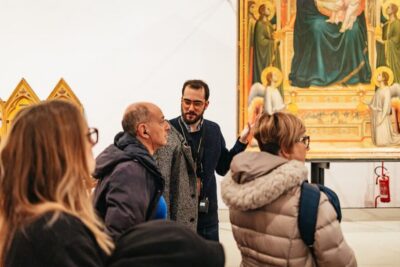
Skip the line: Uffizi and Accademia Small Group Walking Tour
Read our review →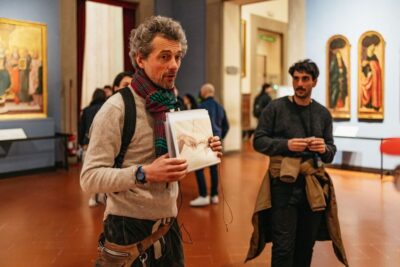

Accademia Gallery Guided Tour with Entry Ticket
Read our review →Browse the lists this tour appears in