Reviewed · ROME TOURS
The ORIGINAL Fiat 500 Tour of Rome’s 7 Hidden Gems
Rome looks best from a tiny car. This three-hour ride in a classic Fiat 500 gives you a playful way to reach places that large buses cannot, from Trastevere’s narrow lanes to the Aventine Hill keyhole and the old Pyramid of Cestius. I especially like the local guides, who add jokes, Roman stories, and photo help along the way. I also like how much ground you cover without the usual fatigue of a walking tour. The main drawback is the price: at $205.67 per person, this is a costly sightseeing ride, and the exact stops may shift.
The tour runs in a shared convoy of up to 20 people, with morning and afternoon departures. Your own booking can include two or three people, and the cars have room for a maximum of three passengers per booking. Guides such as Alexis, Alex, Francesco, Mike, Marco, Stephanie, Giorgio, and Emmanuele have been praised for making the ride personal and lively. Still, check the meeting details carefully: the stated start is Via Labicana 125, not your hotel.
In This Review
- At a glance: what makes this Fiat tour different
- Why Rome works so well from a Fiat 500
- Caracalla: Rome’s enormous bath complex
- The Aventine keyhole at Piazza dei Cavalieri di Malta
- Parco Savello and the Garden of the Oranges
- Trastevere by tiny streets
- Piazzale Giuseppe Garibaldi: Rome from above
- Circus Maximus and the roar of ancient crowds
- Porta San Paolo and Rome’s pyramid
- The Colosseum from the outside
- Via Galvani and the hill made from broken pottery
- Guides, group size, and the social side
- Is $205.67 per person a fair price?
- Comfort, safety, and meeting details
- Who should book this Rome ride?
- Should you book the Fiat 500 tour?
- FAQ
- How long does the Fiat 500 tour last?
- Where does the tour start and finish?
- Is the tour offered in English?
- How many people can ride in one booking?
- Does the tour include entry to the Colosseum or Baths of Caracalla?
- Are photographs included?
- Are there safety restrictions for the cars?
At a glance: what makes this Fiat tour different
- Nine Rome stops in three hours: You visit ancient baths, hilltop gardens, panoramic terraces, the Colosseum area, and lesser-known archaeological sites.
- A classic Fiat 500 does the hard work: You cover more ground than on foot and can reach narrow streets that larger vehicles cannot.
- Your guide takes photos: Bring your own phone or camera for complimentary pictures during the stops.
- The Aventine views are special: The Knights of Malta keyhole and the Garden of the Oranges offer two memorable looks toward St. Peter’s.
- It is social, not private: The full group can reach 20 people, though you ride in a small car with up to two companions from your booking.
- Safety and comfort need thought: The rear seats have no seat belts, and the cars have no airbags. Passengers over 100 kilograms cannot take part.
Why Rome works so well from a Fiat 500
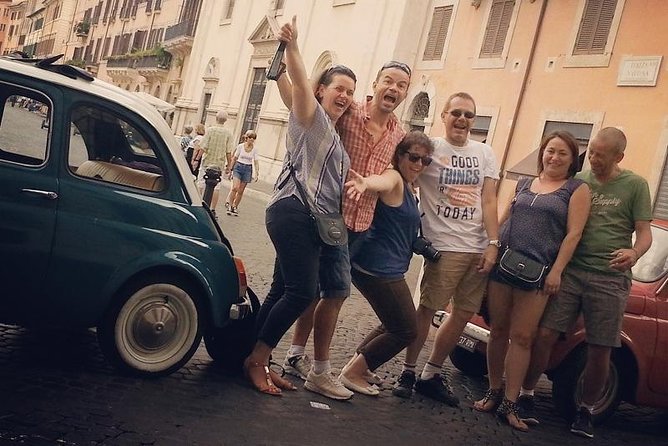
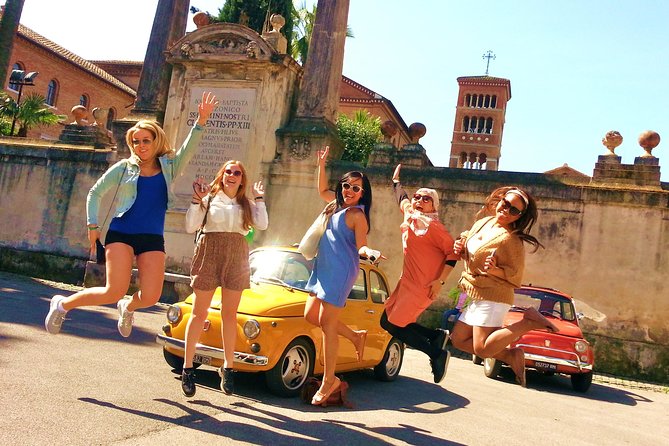
A classic Fiat changes the mood of sightseeing. You are not sealed behind a large coach window, and you are not trying to keep pace with a guide while crossing busy streets. You sit low, move through the city at street level, and become part of the scene for a few hours.
The car itself attracts attention. Several guides have taken passengers through small lanes while people nearby stopped to photograph the Fiat. That attention can be amusing, though it also means this is not a quiet or private way to see Rome.
The strongest part of the experience is the combination of transport and storytelling. Your driver is also your guide, so historical explanations happen while you move between sites. Alexis, in particular, is praised for his humor, energy, and ability to adjust the conversation to a group’s interests. Mike has been singled out for his English, Spanish, and Italian, while Stephanie is praised for useful explanations and taking good pictures.
You should keep your expectations realistic. This is not a full archaeological tour with long lectures inside each monument. Most stops are short, and the value comes from seeing many parts of Rome in one sweep.
A few more Rome bookings to compare
- Vatican: Museums & Sistine Chapel Entrance Ticket
★ 4.5 · 144,003 reviews - Vatican Museums & Sistine Chapel Tour with Optional Basilica
★ 4.3 · 67,413 reviews - Colosseum, Roman Forum & Palatine Guided Tour
★ 4.7 · 63,148 reviews
Caracalla: Rome’s enormous bath complex
The first stop introduces the scale of imperial Rome. The Baths of Caracalla covered an area described as roughly 15 football pitches. They were not simply places to wash. The complex included hot and cold baths, libraries, gyms, theaters, seminar rooms, gardens, and fountains.
You get about 20 minutes here, with no admission fee included because the visit is an exterior stop. That is enough to understand the size of the ruins and take photographs, but not enough for a full visit inside the baths. If Caracalla interests you, you may want to return independently with more time.
This is a good early stop because it gives context to the city’s grand Roman past before the tour moves toward viewpoints and neighborhoods. Your guide can help turn a pile of ancient walls into a picture of daily Roman life.
The Aventine keyhole at Piazza dei Cavalieri di Malta
The keyhole at the Piazza dei Cavalieri di Malta is one of the tour’s best-known photo stops. Look through the famous keyhole, and St. Peter’s appears framed at the far end. The view is often described as showing three countries in a line: Italy, the Vatican, and the sovereign territory associated with the Knights of Malta.
The sight is quick, but memorable. You are not just looking at a church. You are looking through a carefully aligned view that makes distance and borders feel surprisingly close together.
The Fiat adds a second photo opportunity here. Your guide can photograph you beside the small car, using your own phone or camera. If you care about pictures, tell the guide early. The complimentary photo help is one of the practical benefits of this tour.
Parco Savello and the Garden of the Oranges

A short ride brings you to Parco Savello, better known as the Garden of the Oranges. From this hilltop garden, you get a broad view across Rome toward St. Peter’s. The changing perspective creates an optical effect that makes the basilica seem to shift in size as you move through the garden.
The park is also called the Garden of the Lovers, which tells you something about its mood. It is a calmer pause in a busy city, and the garden gives you room to look beyond individual ruins and understand Rome as a city of domes, hills, and layered neighborhoods.
I would not treat this as a replacement for the major Roman viewpoints, but it is a graceful addition. The visit also pairs well with the nearby keyhole stop, giving you two different views of St. Peter’s within a short time.
Still Rome, but a slower afternoon:
- Vatican Museums, Sistine Chapel & St Peter’s Basilica Guided Tour
★ 4.5 · 39,149 reviews - Rome: Colosseum, Palatine Hill and Roman Forum Guided Tour
★ 4.8 · 32,814 reviews - Rome: Guided Tour of Colosseum, Roman Forum & Palatine Hill
★ 4.7 · 27,897 reviews - Rome: Colosseum & Forum with Audio Guide App -Optional Arena
★ 4.2 · 24,770 reviews
Trastevere by tiny streets
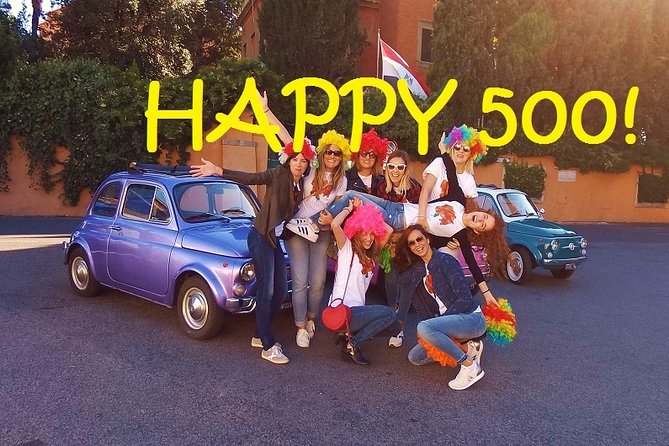
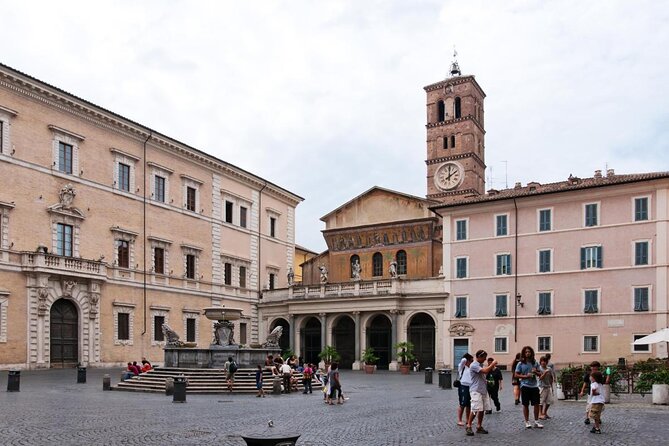
Trastevere is where the Fiat 500 earns its keep. The neighborhood is known for narrow streets, and a small vintage car can move through spaces that would be awkward for a bus or less enjoyable in a large vehicle.
The ride itself is part of the attraction. You may pass through lanes and piazzas while people turn to look at the car. It feels less like being delivered to a monument and more like seeing the city as a moving stage set.
Do not expect a long neighborhood walk from the information provided. The emphasis is on driving through Trastevere, with your guide explaining what you are seeing. If you want time in the neighborhood’s restaurants, churches, or lanes on foot, plan a separate visit.
Piazzale Giuseppe Garibaldi: Rome from above
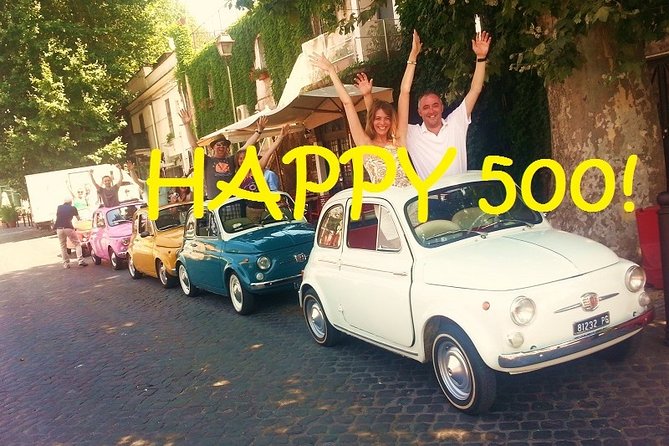
Piazzale Giuseppe Garibaldi offers one of the broadest views of the day. From this terrace, you can look toward the Colosseum, the Pantheon, the Altare della Patria, and the many church domes spread across Rome.
This is the sort of stop that helps you make sense of the city. On the ground, Rome can feel like a series of unrelated ruins, churches, and streets. From above, those pieces connect.
The stop is also useful for photographs, particularly if you want a picture of the city rather than another close-up of a monument. As with the other viewpoints, the light will change depending on your departure time. Morning and afternoon departures give you flexibility, while a 7 p.m. outing can add a different feel to the ride.
Circus Maximus and the roar of ancient crowds
The Circus Maximus was built centuries before the Colosseum and served as Rome’s great chariot-racing arena. The open space today makes it hard to picture the scale, but the site once held crowds estimated at around 250,000 people.
Your guide may use the setting to bring those races to life, including the noise, speed, and danger of the chariots. The site has also hosted modern concerts, including performances by the Rolling Stones, Roger Waters, and Bruce Springsteen.
This is primarily an exterior stop. You will not be entering a reconstructed arena, so the quality of the explanation matters. A strong guide can make the wide, open field meaningful. A weaker guide may leave you looking at grass and scattered ruins.
Porta San Paolo and Rome’s pyramid
Porta San Paolo presents one of Rome’s most surprising sights: an ancient Egyptian-style pyramid built in 18 BCE as the tomb of Gaius Cestius, a wealthy Roman with unusual taste.
The pyramid is often overlooked by people focused on the Colosseum and Vatican. That is exactly why it works well on this tour. You get a sharp reminder that ancient Rome absorbed ideas from across the Mediterranean and that the city’s history does not fit neatly into one Roman style.
The stop is brief, so you should see it as an introduction rather than a full archaeological visit. It is a good example of the tour’s purpose: show you places you might not prioritize on a first walk through the historic center.
The Colosseum from the outside
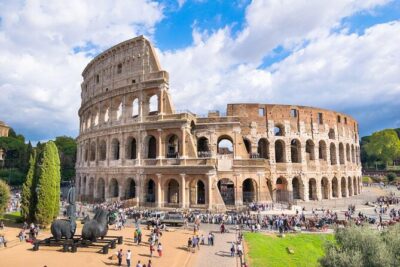
The tour circles the Colosseum, one of Rome’s essential sights. Built around 80 CE, the amphitheater hosted gladiator contests, executions, and naval spectacles. Estimates suggest that around 250,000 people died there over roughly five centuries of use.
The important practical point is that this experience does not include Colosseum admission. You receive a look at the monument as part of the drive, not a timed entrance or interior tour.
The stated plan allows about 20 minutes around this section, but the actual experience can vary. One passenger reported that the car did not stop at the Colosseum as expected. I would treat the Colosseum as a drive-by or exterior viewing opportunity and book a separate ticket if entering the monument matters to you.
That limitation also explains part of the price. You are paying for the car, driver, route, and atmosphere, not for access to Rome’s major paid attractions.
Via Galvani and the hill made from broken pottery
The final stop takes you to Via Galvani and Monte Testaccio, the artificial hill made from broken ancient pottery. Romans built the mound from discarded transport jars used for olive oil, fish sauce, and wine.
The scale is remarkable. The hill is described as about 40 meters high and 700 meters around, formed from fragments of roughly 50 million vessels. It began as a dump and became a permanent feature of the city.
This is a fine ending because it shifts your attention from emperors and arenas to ordinary trade. The pottery tells you about food, shipping, storage, and the daily business that kept Rome supplied.
Some people may find this stop less immediately dramatic than the Colosseum or the Aventine views. I would still rate it highly for its unusual subject. It gives you a piece of Rome that many standard sightseeing routes skip.
Guides, group size, and the social side
The tour is shared, with a maximum of 20 participants, but your own booking must include at least two and no more than three people. You may ride in a convoy with other Fiat 500s, which creates a cheerful group feeling but reduces privacy.
Guide quality appears to be central to the experience. Alexis is repeatedly praised for being funny, energetic, and careful with photographs. Alex has been credited with customizing the outing around passenger interests. Francesco, Marco, Max, Giorgio, Emmanuele, and Stephanie are also praised for humor, explanations, and friendly service.
The information says the guide may be multilingual. English is offered, but you should be prepared for the possibility that the assigned guide speaks more than one language during the outing. One poor experience involved a driver who could not speak English well and a radio that did not work for much of the tour. That seems to be an exception among the supplied feedback, but it is a fair reminder that communication can shape the whole day.
Is $205.67 per person a fair price?
At $205.67 per person, this is not a budget tour. You can visit many Roman viewpoints for the cost of public transport and a little walking, and the major monuments still require separate tickets.
The value comes from convenience and character. You cover nine locations in about three hours, receive a driver and guide, avoid much of the physical strain of walking between distant sites, and get free photo help. You also see areas that are easy to miss on a first visit.
I think the price makes more sense for a first visit of only a few days, a birthday treat, a family with a teenager, or anyone who wants an unusual experience rather than the cheapest route around town. It makes less sense if your main goal is entering the Colosseum, spending time inside Caracalla, or having a private guide.
The experience has received a five-star rating from 172 reviews and is recommended by 99 percent of participants. That strong record reflects how much people value the fun, guides, and chance to cover ground. The four-star and one-star experiences show the risk: unclear stop expectations, communication trouble, and a guide who does not create the right atmosphere can make an expensive tour feel thin.
Comfort, safety, and meeting details
You begin and end at Via Labicana 125, 00184 Rome. Do not assume hotel pickup, since that is not part of the stated meeting arrangement. Confirmation is normally sent at booking, though bookings made within 12 hours of departure are subject to availability.
The cars have no airbags, and the back seats do not have safety belts. Passengers over 100 kilograms are not permitted. Most people can participate, but you should think carefully about getting in and out of a small vintage car before booking.
Free cancellation is available until 24 hours before the start time. A minimum of two people is required for each booking, and the operator may cancel if the minimum number for the activity is not reached.
Who should book this Rome ride?
I would choose this tour if you want a lighthearted way to see Rome beyond the main streets. It suits couples, friends, parents with teenagers, and first-time visitors who want an overview before returning to favorite areas on foot.
It is also a good fit for photography-minded people. The Fiat, the Aventine keyhole, the Garden of the Oranges, and the city terraces give you plenty of picture opportunities, and the guide helps with your phone or camera.
I would be more cautious if you need guaranteed time at every listed stop, require a quiet private tour, dislike small vehicles, or want interior access to major monuments. Ask at the start how the route is expected to run, especially if the Colosseum is important to you.
Should you book the Fiat 500 tour?
Book it if the idea of seeing Rome from a tiny vintage car sounds as appealing as the sights themselves. The best parts are the lively guides, the unusual route, the hilltop views, and the chance to pass through narrow streets in a car that feels completely at home in Rome.
Skip it if $205.67 feels too high for exterior visits, or if you would rather spend three hours inside one or two major monuments. For the right person, this is a memorable orientation ride and a joyful break from standard sightseeing. For others, it is an expensive spin around attractions that deserve more time.
FAQ
How long does the Fiat 500 tour last?
The experience lasts approximately three hours.
Where does the tour start and finish?
It starts at Via Labicana, 125, 00184 Rome, Italy, and ends back at the same meeting point.
Is the tour offered in English?
Yes. English is offered, although the guide may be multilingual.
How many people can ride in one booking?
A booking requires at least two people and can include no more than three people. The shared activity can have up to 20 participants overall.
Does the tour include entry to the Colosseum or Baths of Caracalla?
No admission tickets are included. The stops are sightseeing visits from the outside or brief visits around the sites.
Are photographs included?
Yes. The driver and guide provide free photo shooting with your phone or camera.
Are there safety restrictions for the cars?
Yes. The rear seats do not have seat belts, the cars do not have airbags, and the experience is not suitable for passengers weighing more than 100 kilograms.
Recently added around Rome
- Rome: Pantheon, Trevi Fountain & Roman Squares Guided Tour★ 4.7 · 386 reviews
- Vatican: St. Peter’s Basilica with Audio Guide and Options★ 3.4 · 269 reviews
- Vatican: Pope Francis Tomb and Papal Basilicas Tour★ 4.7 · 340 reviews
- Rome: Vatican Museums Skip-the-line Entry Ticket and Tour★ 4.2 · 400 reviews
- Rome: Vatican Museums & Sistine Chapel Ticket + Tour Options★ 4.7 · 344 reviews
- Vatican: Museums, Raphael & Sistine Chapel + Basilica Option★ 4.7 · 350 reviews
- Vatican Museums & Sistine Chapel Guided Tour★ 4.3 · 832 reviews
- Vatican Museums & Sistine Chapel Entry Ticket★ 4.4 · 245 reviews
Rome Tours, compared.
Vatican Museums & Sistine Chapel Tour with Optional Basilica
Read our review →
Colosseum, Roman Forum & Palatine Guided Tour
Read our review →
Vatican Museums, Sistine Chapel & St Peter’s Basilica Guided Tour
Read our review →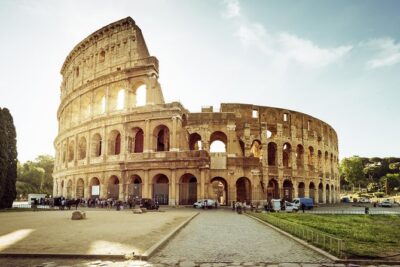
Colosseum, Palatine Hill and Roman Forum Guided Tour
Read our review →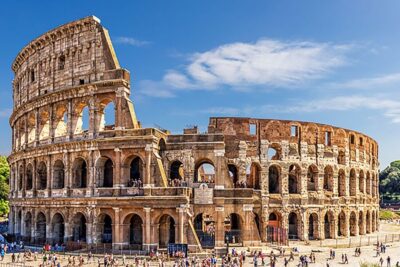
Guided Tour of Colosseum, Roman Forum & Palatine Hill
Read our review →
Colosseum & Forum with Audio Guide App -Optional Arena
Read our review →