
Reviewed · WALKING TOURS
The Best of Florence Walking Tour in a Small Group
Florence rewards walking. This 1-hour-45-minute tour links the Medici quarter, the Duomo, Piazza della Signoria, the Uffizi, Ponte Vecchio, and Palazzo Pitti in one tidy route. I like the 15-person group limit and the chance to hear local advice on food, side streets, and what to see next. I also like the wireless whisper system, which keeps the guide audible in crowded squares.
The main consideration is pace. Fourteen stops in less than two hours means most visits are brief, often about five minutes, and the listed admission tickets are generally not included. This is an orientation walk, not a museum tour. If you want long visits inside the Medici Chapels or Uffizi, you will need separate time and tickets.
In This Review
- Key points to know before you book
- Why this short Florence walk works well
- San Lorenzo and the Medici family’s first statement
- Medici Chapels and Palazzo Medici Riccardi
- The Duomo complex in a concentrated burst
- From republican Florence to Medici rule
- Crossing the Arno at Ponte Vecchio
- Palazzo Pitti and the final Medici chapter
- The guides make or break the experience
- What the $59.26 price buys you
- Who should book this walking tour?
- My call: book it for orientation, not admission
- FAQ
- How long does The Best of Florence Walking Tour last?
- What time does the tour start?
- Where does the tour begin?
- Where does the tour end?
- How large is the group?
- Are admission tickets included?
- Is free cancellation available?
Key points to know before you book
- The route covers Florence’s essential center: You move from San Lorenzo and the Medici family sites to the Duomo, political Florence, the Arno, and Palazzo Pitti.
- Small means genuinely manageable: Groups are capped at 15 people, with a whisper system to help you hear in busy streets.
- The best use is early in your stay: The walk gives you a useful map of the city and practical ideas for meals, shops, churches, and later sightseeing.
- Guides add personality: Manuel, Camilla, Simona, Samona, Sarah, and other guides are praised for humor, local insight, and clear storytelling.
- It is mostly an exterior overview: The tour pauses at many major landmarks but does not include most admission tickets.
- The meeting point is central: Begin at Caffè Scudieri Firenze at 12:15 pm, then finish near Ponte Vecchio.
Why this short Florence walk works well
Florence is compact, but its story is not. A few streets can take you from a Medici church to a Gothic cathedral, then to a Renaissance palace, a civic square, and a medieval bridge. Without a guide, it is easy to admire the stonework while missing the power struggles behind it.
This walk gives you that larger picture. The route connects the Medici banking family, the church, the republic, the grand-ducal court, and the artists who served them. You are not simply checking off famous buildings. You are following how Florence changed from a medieval city into the center of Renaissance culture.
I especially like the tour as a first-day activity. The walk helps you understand where the major sights sit in relation to one another. It also gives you a chance to ask what deserves your limited museum time. Guides have offered advice about food, drinks, shops, churches, street food, and less obvious corners of the center.
The timing is worth noting. You start at 12:15 pm, when Florence can be sunny and crowded. Simona has been praised for moving the group into the shade during stops, a small courtesy that matters during a warm afternoon. Comfortable shoes, water, and sun protection are sensible choices.
More Walking Tours in Florence
- Florence: Guided Walking Tour
★ 4.5 · 3,334 reviews - Skip the line: Uffizi and Accademia Small Group Walking Tour
★ 4.5 · 3,135 reviews - Florence: Guided Walking Tour
★ 4.6 · 1,602 reviews
San Lorenzo and the Medici family’s first statement
The walk begins near Caffè Scudieri Firenze in Piazza di San Giovanni, then heads toward the Basilica di San Lorenzo. The church sits in the heart of Florence’s market district and is closely tied to the Medici family. Its importance comes not only from its size or age, but from the family members buried there, including major Medici rulers from Cosimo il Vecchio through Cosimo III.
The stop is listed at about five minutes, with admission not included. That tells you what to expect: a guide’s explanation outside or a quick orientation, not a full church visit. If the basilica matters to you, plan a separate return visit.
Nearby, the Biblioteca Medicea Laurenziana introduces a different side of Medici ambition. The library was backed by Medici pope Clement VII and held manuscripts and books from the family’s private collection. Michelangelo designed its celebrated architecture, which makes this a useful stop even if you are more interested in buildings than books.
Again, the scheduled pause is only about five minutes. You will get the story and architectural context, but not time to study the library at leisure. I would mark it as a place to revisit if you enjoy Michelangelo’s work beyond sculpture.
Medici Chapels and Palazzo Medici Riccardi
The Cappelle Medicee were built as an extension to San Lorenzo between the 16th and 17th centuries. Their purpose was clear: to honor the Medici family, the church’s patrons and the Grand Dukes of Tuscany. Michelangelo designed the Sagrestia Nuova, or New Sacristy, giving the complex a direct link to one of Florence’s most important artists.
This is one of the stops where the tour’s limits are most obvious. Five minutes can explain why the chapels matter, but it cannot replace seeing the interiors, sculpture, and tombs in person. Admission is not included, so keep the chapels on your independent sightseeing list if they interest you.
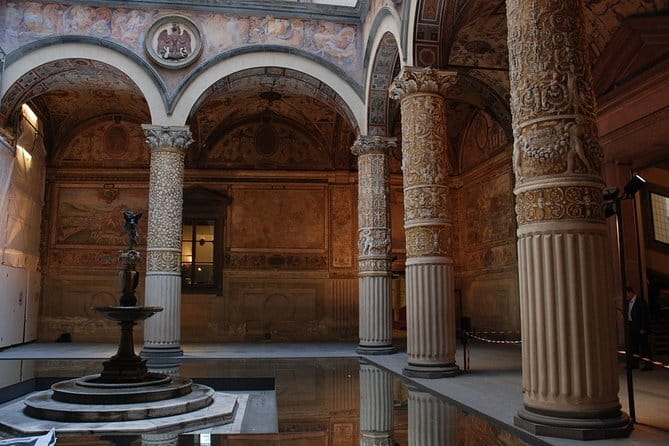
The Palazzo Medici Riccardi follows naturally. Built for Cosimo de’ Medici between 1444 and 1484, it tells you how the family presented itself in public. It was a residence for a banking dynasty that wanted power without looking like it was shouting about power. That tension is one of the useful themes a good guide can bring out.
The first section of the route is particularly strong for understanding the Medici. You see their church, their library, their chapels, and their palace in close succession. If you know little about Florence before arriving, this sequence gives the city’s political story a clear beginning.
The Duomo complex in a concentrated burst
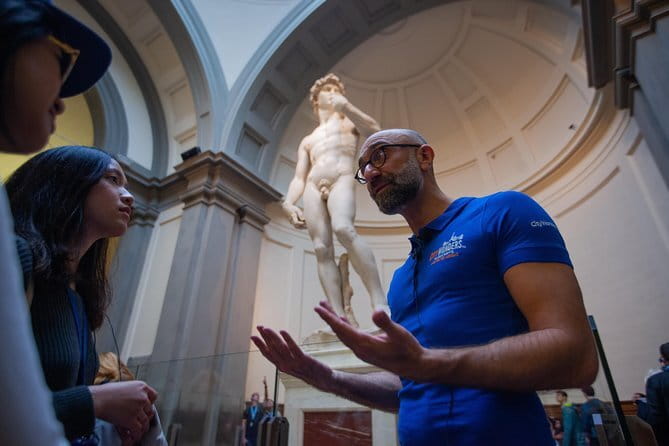
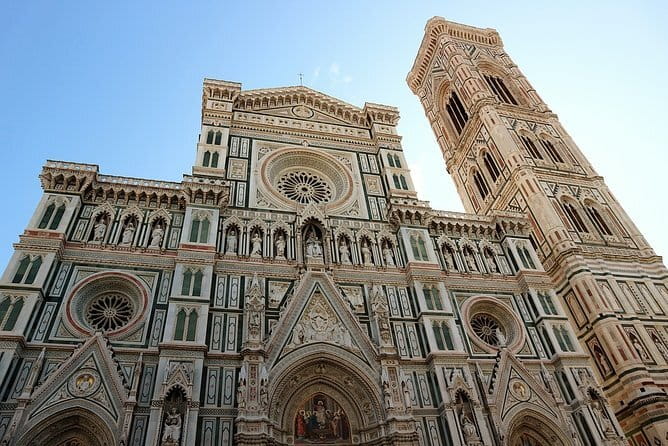
The route then reaches Piazza del Duomo, Florence’s most recognizable cluster of buildings. You see Santa Maria del Fiore, the Baptistery of San Giovanni, Brunelleschi’s dome, and Giotto’s Campanile. The cathedral is listed twice in the route, so treat those entries as repeated orientation around the same major complex rather than two separate attractions.
The cathedral began in 1296 in the Gothic style under the direction of Arnolfo di Cambio. Its marble façade uses white, green, and pink, while the wider complex forms part of Florence’s UNESCO-listed historic center. The tour pauses here for about five minutes, and the cathedral entry is shown as free, but the walk is not presented as a full interior visit.
The Baptistery across from the cathedral is one of Florence’s oldest buildings. Its construction dates from 1059 to 1128, and its Florentine Romanesque design gives you a different visual language from the cathedral beside it. The outside alone makes the relationship between the buildings easy to grasp.
Brunelleschi’s dome deserves special attention. It was once the largest dome in the world and remains the largest brick dome ever constructed. The tour allows about ten minutes here, which is longer than at most stops. That extra time gives the guide room to explain the engineering problem and why the dome remains one of the great achievements in architectural history.
Do not confuse this stop with a dome climb. The supplied details do not include admission, reservations, or access to the cupola. If climbing the dome is one of your Florence goals, arrange that separately and confirm the operator’s exact inclusions before booking.
Giotto’s Campanile completes the group. The tower is known for its Florentine Gothic design, sculptural decoration, and colored marble. You get a quick explanation of how the campanile fits into the cathedral complex, but you will not have time to climb it during this short stop.
Still Florence, but a slower afternoon:
- Florence: Skip-The-Line Uffizi Gallery Timed Entry Ticket
★ 4.5 · 27,832 reviews - Tuscany Day Trip from Florence: Siena, San Gimignano, Pisa and Lunch at a Winery
★ 5.0 · 21,634 reviews - Florence: Timed Entrance Ticket to Michelangelo’s David
★ 4.6 · 16,983 reviews - Florence: Michelangelo’s David Skip-the-Line Entry Ticket
★ 4.5 · 12,764 reviews
From republican Florence to Medici rule
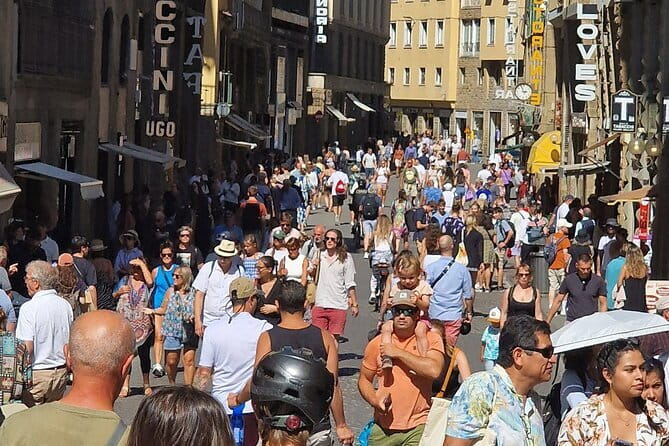
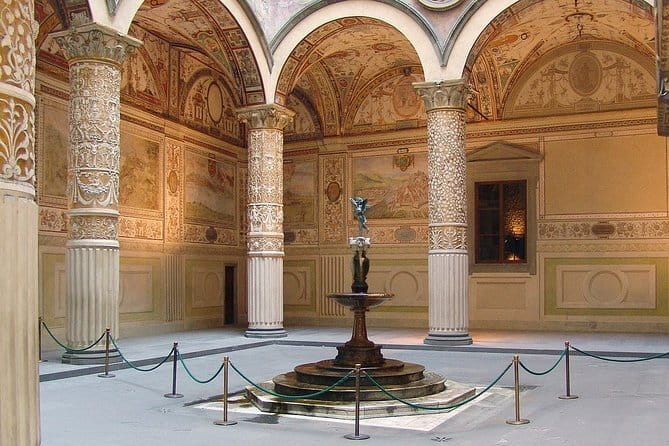
After the Duomo, the route moves to Piazza della Signoria. This L-shaped square is one of the city’s main public rooms, placed in front of Palazzo Vecchio and near the entrance to the Uffizi Gallery. It is also where the tour shifts from religious and family power to civic power.
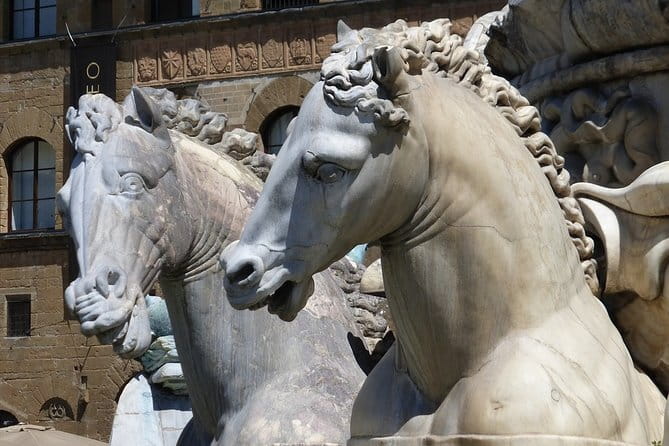
Palazzo Vecchio was Florence’s town hall and remains an imposing fortress-palace. Its position facing the square makes the political message hard to miss. The nearby copy of Michelangelo’s David and the statues in the Loggia dei Lanzi create an open-air introduction to Florence’s taste for linking art with public authority.
The five-minute stop is enough to explain the square and point out the major sculptures. It is not enough for the palace museum, whose admission is not included. You can use the guide’s overview to decide if the interior deserves a later visit.
The Uffizi comes next. Giorgio Vasari began the complex in 1560 for Cosimo I de’ Medici, originally as offices for Florentine magistrates. The name comes from uffizi, meaning offices. The building later became one of the world’s best-known art museums, especially for its Renaissance collection.
This tour does not include Uffizi admission, and the stop lasts about five minutes. That is useful for location and planning, but not for viewing Botticelli, Leonardo, Michelangelo, or the other major works inside. If you have a fixed museum schedule, note that this walking tour does not substitute for an Uffizi reservation.
Crossing the Arno at Ponte Vecchio
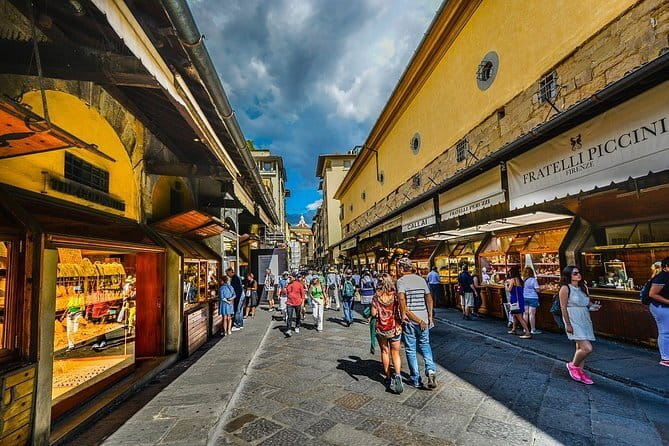
Ponte Vecchio gives the walk a change of mood. This medieval bridge is the oldest bridge over the Arno in Florence and is famous for shops built directly along it. Butchers, tanners, and farmers once occupied those spaces. Jewelers and art dealers now fill them.
The bridge is a free public landmark, and the tour ends in this area. That makes the endpoint practical for continuing toward the Oltrarno, returning to the historic center, or stopping for your own meal. The exact endpoint can vary slightly within the indicated area, so listen for the guide’s final instructions rather than expecting a precise doorway.
Ponte Vecchio is also a good place to notice how Florence mixes daily life with major monuments. It is not only a postcard view. It remains a working crossing, a shopping street, and a natural pause along the Arno.
Palazzo Pitti and the final Medici chapter
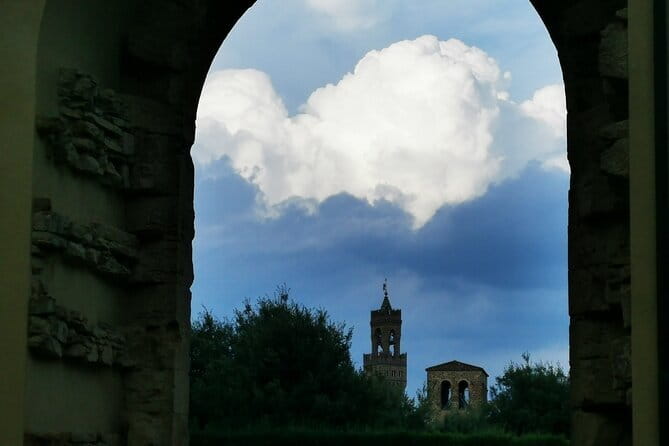
The final listed stop is Palazzo Pitti on the Oltrarno side. The Medici bought the palace in 1549, and it became the main residence of the ruling families of the Grand Duchy of Tuscany. Over time, it grew into a vast storehouse for paintings, silver, jewelry, plates, and other luxury possessions.
The palace is another place where the tour provides context rather than an extended indoor visit. Admission is not included, and the five-minute stop is best understood as a recommendation and orientation. If you want to see the collections, gardens, or rooms, schedule a separate visit.
Ending near Pitti after crossing Ponte Vecchio gives the route a satisfying arc. You begin with the Medici in their original neighborhood around San Lorenzo and finish with the grand court they created across the river. In less than two hours, the guide traces the family’s rise from merchants and bankers to rulers of Tuscany.
The guides make or break the experience
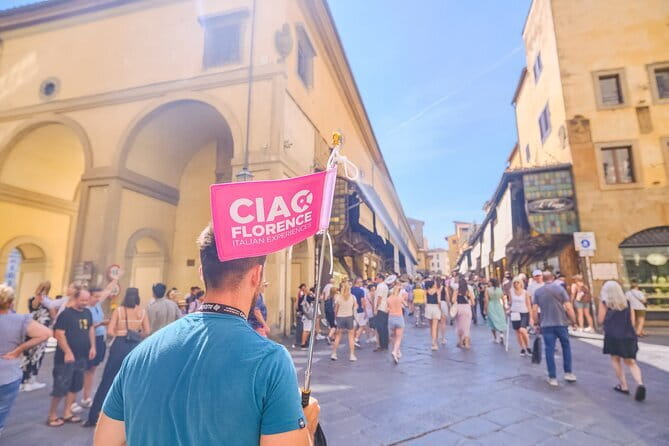
The strongest part of this tour is the human delivery. Manuel is praised for making Florence’s story fun, using humor, local details, and a clear narrative. He has also adapted the walk for families and for people who wanted less touristy streets, which suggests a flexible approach when the group allows it.
Camilla is noted for her passion for Florence’s art, architecture, and history, along with recommendations for backstreet shops and churches. Simona brings humor and personal stories, while Samona has been singled out for her command of Florence’s past and her engaging style. Sarah is also praised for answering questions and explaining the city’s famous families and sculptors.
You should not assume you will receive a particular guide. Still, the repeated praise for different guides points to a consistent strength: the tour depends on people who care about the city and can connect buildings to stories. The best guides do more than recite dates. They point out details you might walk past and help you see how the city works.
The wireless whisper system is a practical plus. With up to 15 people, the group is small by city-tour standards but still large enough for voices to disappear at a busy intersection. The earpiece lets you look at a façade without crowding around the guide.
What the $59.26 price buys you
At $59.26 per person, this is not the cheapest way to walk around Florence, since the historic center is easy to explore on your own. The value comes from the guide’s interpretation, the efficient route, and the local recommendations that can shape the rest of your visit.
The price makes more sense if you are in Florence for a short stay, arriving for a day from Rome, or feeling overwhelmed by the number of major sights. One especially useful account came from a couple who wanted a quick but insightful introduction during a day trip. The walk helped them understand the city and decide what they wished they had more time to see.
It is less good value if you expect museum entry, long interior visits, or a leisurely pace at every landmark. Most stops are five minutes, and several admission tickets are excluded. Think of the fee as paying for a guided map and a story, not an all-access sightseeing pass.
Group discounts may help reduce the cost for larger parties. Free cancellation is available if you cancel at least 24 hours before the 12:15 pm start. Poor weather or failure to meet the minimum group size can lead to another date, another experience, or a full refund.
Who should book this walking tour?
I would choose this for a first visit, especially if you want Florence explained before tackling its museums. It suits couples, families, solo visitors, and anyone who prefers a human guide to a screen or audio app. Most people can participate, service animals are allowed, and the meeting point is near public transportation.
Families may benefit from asking for an engaging guide and keeping children involved with questions about the buildings and artists. The small group helps, though the route still includes nearly two hours on foot and short stops in crowded public areas.
Art lovers should see this as a preview. You will learn where the Uffizi, Medici Chapels, Palazzo Vecchio, and Palazzo Pitti are and why they matter, then return with more time. Architecture fans may get the most from the Laurenziana Library, the Duomo complex, the dome, and Giotto’s Campanile.
Food-focused visitors will appreciate the practical recommendations, particularly if you ask about street food and places to eat. The exact advice depends on your guide, but the tour is designed to help you plan beyond the walk.
My call: book it for orientation, not admission
I recommend The Best of Florence Walking Tour in a Small Group if you want a compact, well-told introduction to Florence. The route is broad, the group is capped at 15, the whisper system is useful, and the guides bring local personality to a city that can otherwise feel like one grand museum corridor.
Book it early in your stay so you can use the advice afterward. Do not book it expecting full visits to the Uffizi, Medici Chapels, Palazzo Vecchio, Palazzo Pitti, or the dome. For that, you need separate tickets and more time.
At $59.26, the tour earns its price when it saves you confusion and gives you a strong story for the rest of Florence. If you want a fast, friendly overview with real local pointers, it is a solid choice.
FAQ
How long does The Best of Florence Walking Tour last?
The tour lasts approximately 1 hour and 45 minutes.
What time does the tour start?
The tour starts at 12:15 pm.
Where does the tour begin?
It begins at Caffè Scudieri Firenze, Piazza di San Giovanni, 19R, 50123 Firenze FI, Italy.
Where does the tour end?
It ends near Ponte Vecchio. The exact endpoint may vary slightly within the indicated area.
How large is the group?
The group has a maximum of 15 travelers.
Are admission tickets included?
Most admission tickets are not included. The cathedral entry is listed as free, but the tour details do not describe extended interior access or admission to the dome, museums, chapels, or palaces.
Is free cancellation available?
Yes. You can cancel at least 24 hours before the experience start time for a full refund. Cancellations or changes made less than 24 hours before the start time are not refunded or accepted.
Recently added around Florence
- Florence Uffizi Gallery monolingual Small Group Tour★ 4.0 · 621 reviews
- Florence Private Walking tour with Skip-the-line to Accademia★ 4.5 · 236 reviews
- Uffizi Gallery Entrance Ticket with Priority Access★ 3.5 · 1,029 reviews
- Florence Skip-the-Line Duomo Tour with Guide & Brunelleschi Dome★ 5.0 · 1,176 reviews
- Skip-the-Line Accademia Guided Visit: David Secrets and Beyond★ 4.0 · 525 reviews
- Priority Entrance : Florence Accademia Gallery Timely Tickets★ 4.0 · 603 reviews
- Skip the line : David Guided Experience★ 4.5 · 1,076 reviews
- Private Tour in Siena, San Gimignano and Chianti Day Trip from Florence★ 5.0 · 405 reviews
Walking Tours, compared.
Guided Walking Tour & Last Supper Visit with Ticket
Read our review →
Rialto Bridge & Offbeat Unusual Venice Walking Tour
Read our review →
Private 3 hrs Venice Tour: St Mark’s, Walking tour & Boat tour
Read our review →
Skip the line: Uffizi and Accademia Small Group Walking Tour
Read our review →Browse the lists this tour appears in