Reviewed · ROME TOURS
Taste of Testaccio: Special 15 Year Anniversary Edition
Rome tastes better beyond the big sights. This 3.5-hour Testaccio walk takes you into a neighborhood where market stalls, family food shops, and traditional restaurants still shape daily life. I especially like the hands-on market stop, where you make bruschetta with fresh tomatoes, and the chance to try three classic Roman pastas in one sitting. The Egyptian-style pyramid and Protestant Cemetery add useful context between meals.
I also like the small maximum group of 12, which makes it easier to hear your guide and ask questions. Guides such as Luca, Katherine, Francesca, Giuseppe, and Valter have been praised for making the tour friendly and conversational, not like a history lecture. The main caution is the amount of food and walking in roughly three and a half hours. On a hot Roman day, as one guest discovered, the outdoor portions can feel demanding.
In This Review
- Key points to know before booking
- Why Testaccio is the right neighborhood for a food tour
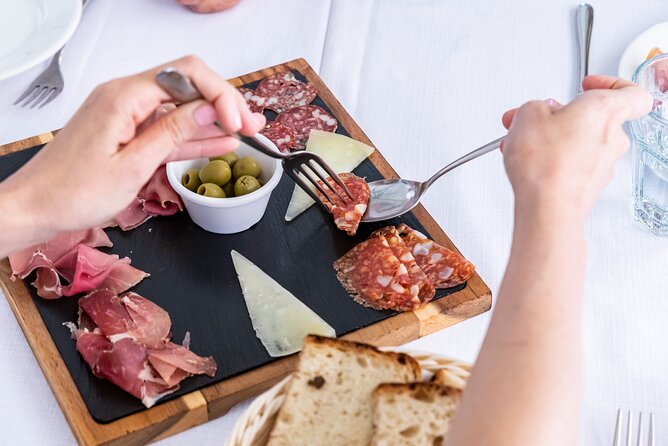
- Starting with cheese, cured meat, and Prosecco
- The Pyramid of Cestius and Testaccio’s unusual history
- Making bruschetta inside Testaccio Market
- Supplì and trapizzino, Rome’s serious street food
- Three Roman pastas at Flavio al Velavevodetto
- Monte Testaccio and the city’s old food supply
- Ending with Giolitti gelato and an espresso
- Group size, guides, and the feel of the walk
- Is $131.81 a fair price?
- Food restrictions, heat, and practical planning
- Who should book this Testaccio food tour?
- Should you book Taste of Testaccio?
- FAQ
- Where does the Taste of Testaccio tour begin?
- Where does the tour end?
- How long does the tour last?
- What language is the tour offered in?
- How many people can join the tour?
- Does the tour require a minimum number of participants?
- What food is included?
- Can dietary requirements be accommodated?
- Are children allowed on the tour?
- Can I cancel for a full refund?
Key points to know before booking
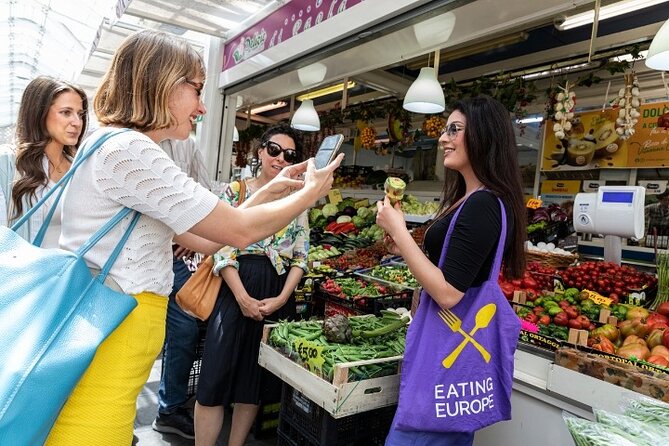
- Testaccio Market gives you a hands-on tasting: You make bruschetta with ingredients bought from market vendors, then sample buffalo mozzarella, caprese salad, and fried Roman specialties.
- The pasta course is unusually generous: Carbonara, amatriciana, and cacio e pepe are served together at Flavio al Velavevodetto, with local wine.
- You explore a less-touristed side of Rome: The route includes the Pyramid of Cestius, the Protestant Cemetery, the former slaughterhouse district, and Monte Testaccio.
- The group stays small: The tour is limited to 12 people, and it requires at least two participants to operate.
- Gelato comes with a lesson: At historic Giolitti, you learn how authentic artisan gelato differs from the brightly colored, overfilled displays often aimed at tourists.
- The food usually replaces a meal: Come hungry, since the tastings include charcuterie, cheese, wine, bruschetta, supplì, trapizzino, pasta, pastry, espresso, and gelato.
Why Testaccio is the right neighborhood for a food tour
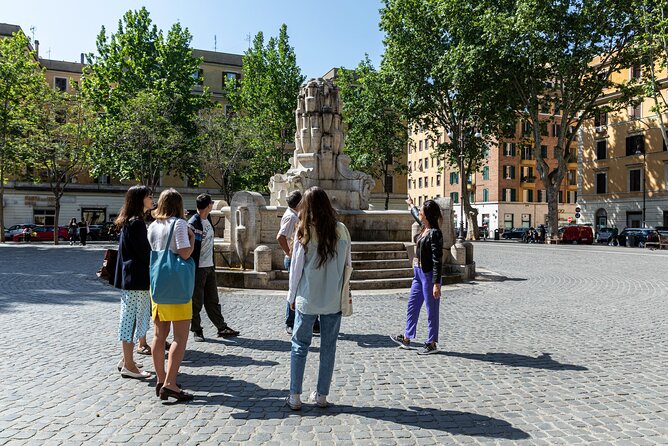
Testaccio sits south of Rome’s ancient center, away from the usual Colosseum and Trevi Fountain circuit. That distance matters. You get a look at a Roman district shaped by food work, neighborhood commerce, and working-class traditions rather than grand monuments alone.
The area’s culinary identity comes partly from its former slaughterhouse. Workers once handled cuts of meat that wealthier Romans often ignored. Those less fashionable pieces became the basis for quinto quarto, or fifth-quarter cooking, a Roman tradition built around offal and other inexpensive cuts.
You do not need to be eager to eat every unusual part of the animal to appreciate the story. The guide explains how Testaccio’s food developed, then leads you to more familiar dishes such as pasta, mozzarella, cured meats, and gelato.
I like the balance here. You are not simply moved from one restaurant to the next. The walk connects what you eat with the neighborhood around you, including the market, the former slaughterhouse complex, Monte Testaccio, and the Pyramid of Cestius.
A few more Rome bookings to compare
- Vatican: Museums & Sistine Chapel Entrance Ticket
★ 4.5 · 144,003 reviews - Vatican Museums & Sistine Chapel Tour with Optional Basilica
★ 4.3 · 67,413 reviews - Colosseum, Roman Forum & Palatine Guided Tour
★ 4.7 · 63,148 reviews
Starting with cheese, cured meat, and Prosecco
The first food stop is Salumeria Volpetti, a long-established shop with about 150 cheeses. You begin with a selection of Italian charcuterie and artisanal cheeses, along with olive oil and balsamic vinegar. A glass of Prosecco provides the celebratory opening expected from a 15-year anniversary edition.
This is a smart first stop because it introduces you to the basics of Italian food shopping. You can compare textures and flavors while your guide explains how the products fit into Roman eating habits. The stop lasts about 40 minutes, so it is not just a quick nibble at a counter.
The shop is also useful if you want to buy edible souvenirs. The tour itself does not include hotel transfer, and extra drinks are not included, but Volpetti gives you a chance to notice products you may want to return for later.
You may also visit a historic pastry shop such as Barberini, where baked treats have been served for more than 50 years. The exact food stops can vary by season and day, so do not treat every item as fixed. The overall pattern remains local snacks, traditional dishes, and plenty of explanation.
The Pyramid of Cestius and Testaccio’s unusual history
After the opening tastings, the route turns toward Piramide Cestia. This authentic Egyptian-style pyramid is about 2,000 years old, built in the heart of Rome as a tomb for Gaius Cestius.
You stop for around 15 minutes. That is enough time to see the monument and hear why this striking structure sits here, without turning the tour into a long archaeological visit. The pyramid is one of the city’s more surprising sights, especially if you have already seen Rome’s better-known ancient monuments.
The route also points out the Protestant Cemetery, where the poet John Keats is buried. These brief stops add a quieter side to Rome. They are not substitutes for a full cemetery or archaeology tour, but they make the walk more memorable and give you useful sights to revisit.
The outdoor sections are exposed to the weather. A hot day can make the walk tiring, so bring water and wear comfortable shoes. The tour is accessible to most people, and service animals are allowed, but you should still be prepared to walk between food stops.
Making bruschetta inside Testaccio Market
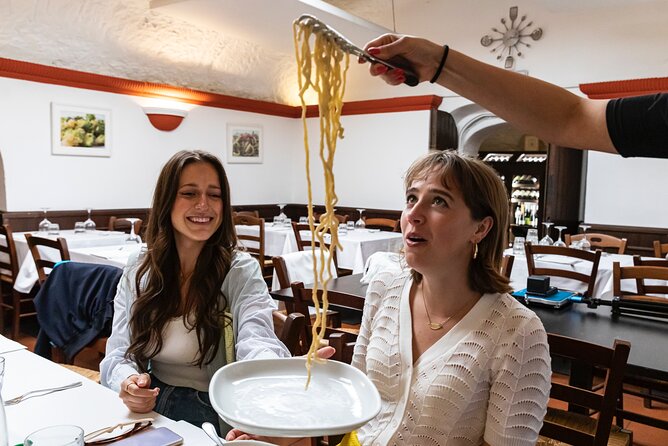
Testaccio Market is the heart of the food portion. Rather than simply watching a vendor prepare something, you make your own bruschetta using fresh ingredients purchased from the market stalls.
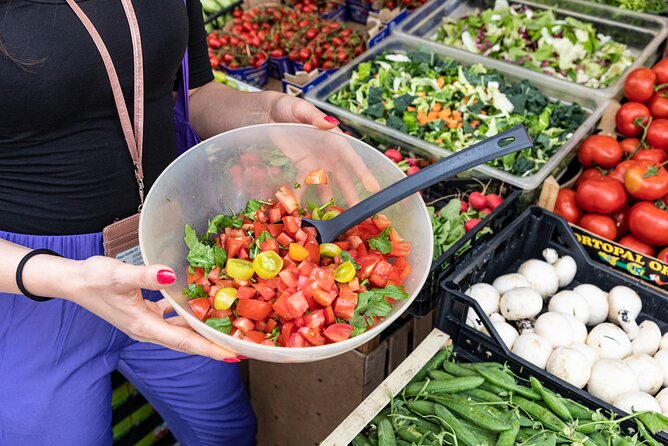
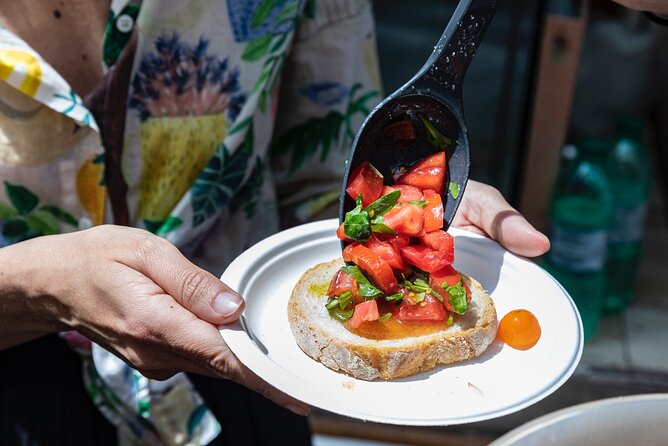
That small task changes the feel of the visit. You see the tomatoes, bread, garlic, cheese, and other produce before tasting them. One guide, Giuseppe, was praised for gathering the ingredients from several vendors and having the bruschetta assembled fresh. It is a good reminder that Italian food often depends on the quality of a few simple ingredients.
The market tasting can include buffalo mozzarella, caprese salad, classic fried street food, and a local beer. The tomatoes are a particular highlight, and the caprese offers a useful contrast between creamy cheese and fresh produce.
Allow about 45 minutes here. That gives you time to eat, look around, and hear about the vendors. If you enjoy food markets, this may be the most rewarding section of the tour. You can return later on your own, since the market is a place to browse as much as to taste.
One practical point: this is a working market, not a staged attraction. Stop locations and dishes may change, and the pace depends partly on vendor availability. That flexibility can be a benefit, though anyone expecting a fixed menu should keep that in mind.
Still Rome, but a slower afternoon:
- Vatican Museums, Sistine Chapel & St Peter’s Basilica Guided Tour
★ 4.5 · 39,149 reviews - Rome: Colosseum, Palatine Hill and Roman Forum Guided Tour
★ 4.8 · 32,814 reviews - Rome: Guided Tour of Colosseum, Roman Forum & Palatine Hill
★ 4.7 · 27,897 reviews - Rome: Colosseum & Forum with Audio Guide App -Optional Arena
★ 4.2 · 24,770 reviews
Supplì and trapizzino, Rome’s serious street food
The next tastings introduce two Roman street foods that are easy to miss if you stick to standard restaurant meals.
Supplì is a fried rice ball, usually filled with cheese and tomato sauce. It is Rome’s answer to the idea of a portable snack, with a crisp outside and soft center. You try one at Trappizino, along with other local fried foods and a beer.
Trapizzino is another Roman specialty. It is a pocket of pizza bianca filled with saucy dishes, in this case hunter-style chicken. It looks casual, but it carries the logic of Roman home cooking: bread becomes a useful vessel for a hearty filling.
These stops work well because they show a different side of Roman food from the pasta course later on. The dishes are informal, filling, and rooted in everyday eating. If you are not hungry at the start, you will probably be ready for a proper meal by this point.
Three Roman pastas at Flavio al Velavevodetto
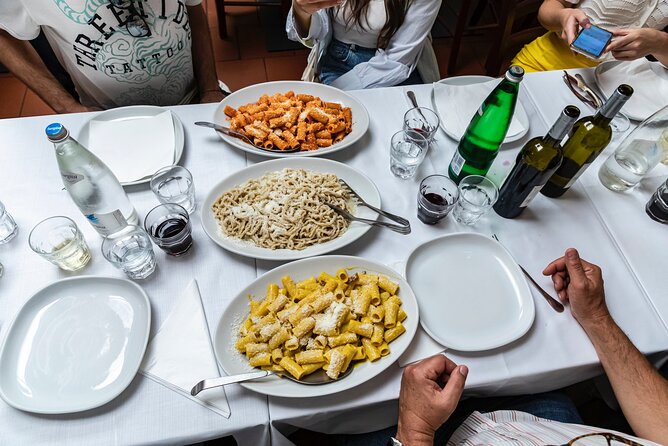
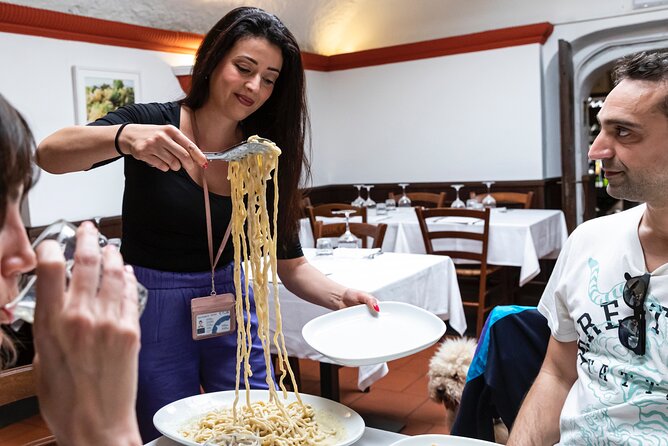
The main seated meal takes place at Flavio al Velavevodetto, a respected Testaccio restaurant. Here you taste three of Rome’s best-known pasta dishes: carbonara, amatriciana, and cacio e pepe.
Carbonara is creamy from eggs and cheese, with cured pork adding salt and depth. Amatriciana brings tomato and pork together in a more direct sauce. Cacio e pepe is the simplest of the three, built around cheese and black pepper, but it is also the dish most likely to expose poor technique.
Trying all three in one meal lets you compare the sauces rather than judging each in isolation. I find that especially useful for first-time visitors, since menus across Rome often list these dishes without much explanation. Your guide can help you understand what makes each recipe distinct and how Roman cooking keeps a short ingredient list under control.
The restaurant stop lasts about 30 minutes according to the schedule, though meal timing may vary. Local wine is paired with the pasta, and the portion sizes across the tour are substantial. You should not plan a large dinner immediately afterward.
This is also where the tour’s value becomes clearer. A plate of pasta alone does not justify a $131.81 price, but the tour combines three pasta tastings with market food, charcuterie, street snacks, drinks, dessert, and neighborhood guiding. It is priced as a full food experience rather than a simple restaurant meal.
Monte Testaccio and the city’s old food supply
The walk includes Monte Testaccio, an artificial hill made from fragments of millions of ancient Roman olive oil amphorae. These broken vessels were discarded in one place over centuries, forming a mound that tells you something about the scale of Roman food distribution.
This stop is easy to overlook if you visit Rome only for imperial monuments. The hill connects archaeology with appetite. Rome needed enormous amounts of olive oil, and the remains of that supply system are still visible in the neighborhood.
You also pass the former city slaughterhouse, a major part of Testaccio’s food identity. The guide explains how the site influenced local recipes and employment. These details give the neighborhood a stronger sense of place than a food walk built only around fashionable restaurants.
The route does not promise a long interior visit to every historic site. Think of these as short guided discoveries between tastings. That arrangement suits you if you want food and context in equal measure, but it may disappoint if your main goal is extended sightseeing.
Ending with Giolitti gelato and an espresso
The final stop is Giolitti Caffe and Gelateria, described as more than 100 years old. You finish with artisan gelato, espresso, and a typical Italian pastry.
The gelato lesson is one of the more practical parts of the tour. Your guide explains how to spot authentic gelato, including why natural colors and restrained presentation can be better signs than towering, brightly colored piles. You leave with advice that can help on the rest of your Rome visit.
The stop lasts about 25 minutes. It is a sensible ending after salty foods and pasta, and the cold dessert is especially welcome on a warm afternoon. Several guides received specific praise for making this final stop memorable, and one guest advised saving room for it.
The tour ends on Via Amerigo Vespucci, just a couple of blocks from the starting point. That makes the route easy to understand, though you should not expect to finish at a major train station or famous central monument.
Group size, guides, and the feel of the walk
The maximum group size is 12. That is small enough for a guide to manage conversations and help with questions, while still giving the tour a social feel. Some departures may be smaller, and one particularly relaxed outing had only two participants.
The guide can shape the experience more than any single food stop. Luca has been praised for combining food knowledge with history and a friendly manner. Katherine has been described as engaging and attentive, while Francesca is noted for her rapport with local vendors and for making a group feel welcome.
Other named guides include Valter, Giuseppe, Gianluca, Valeria, Amin, Gabriele, Giorgia, Fabio, and Rishad. You should not book based on a specific guide unless the company confirms that person, but the repeated pattern is encouraging: the best guides explain rather than lecture, keep the group moving without rushing, and connect food to Roman life.
The tour is offered in English. It needs at least two participants to run, and the company will contact you if that minimum is not met.
Is $131.81 a fair price?
At $131.81 per person, this is not a bargain food crawl. It is also not an unreasonable price if you would otherwise pay separately for several tastings, drinks, a full pasta meal, dessert, and a guide.
The value is strongest for first-time visitors who want an organized introduction to Roman food. You get more than a list of restaurants. The route shows how the market, slaughterhouse traditions, ancient trade, and neighborhood restaurants fit together.
The price is harder to justify if you already know Testaccio well, speak Italian comfortably, or prefer to choose every dish yourself. You may be able to eat for less by visiting the market and one restaurant on your own. In that case, you are paying for access, structure, explanations, and the convenience of several tastings in one afternoon.
Group discounts may be available. Gratuities, hotel pickup and drop-off, and extra drinks are not included, so budget for those separately.
Food restrictions, heat, and practical planning
Vegetarian and gluten-free requests may be accommodated if you email ahead or add a note when booking. The company cannot accept responsibility for severe or life-threatening allergies to ingredients used on the tour, so this is not a safe choice for anyone with that level of risk.
Children under four can join without a ticket, but food is not included for children aged three and under. Paid food tickets are available from age four.
You should eat a light breakfast or early snack, then arrive ready for a great deal of food. Comfortable shoes are essential, and water is sensible, particularly in summer. The outdoor walk includes several historic sights, while the food stops provide opportunities to sit and cool down.
Free cancellation is available up to 24 hours before the start time. Cancellations or changes made inside that window are not refunded.
Who should book this Testaccio food tour?
I would choose this tour if you want to understand Rome through what people eat, not just through monuments. It suits curious first-time visitors, couples, families with older children, and anyone who likes a small group with a guide who can answer questions.
It is also a good choice if you are nervous about ordering Roman specialties on your own. You get a broad sample, including dishes you might not recognize on a menu, without committing to a full serving of every item.
I would hesitate if you dislike rich food, struggle with extended eating, or want a quiet sightseeing walk. The itinerary is food-heavy, and the combination of heat, walking, and multiple courses can be a lot. People with serious food allergies should choose another activity.
Should you book Taste of Testaccio?
Yes, if you want a substantial introduction to Roman food in a neighborhood beyond the usual sightseeing route. The market, three pasta sauces, supplì, trapizzino, gelato lesson, and unusual ancient sights give the tour real range.
Book it early, since it is often reserved about 62 days ahead. Come hungry, tell the company about dietary needs before arrival, and save enough energy for the walk between courses. If your idea of a good Rome afternoon includes eating well while learning why the neighborhood tastes the way it does, this is a strong choice.
FAQ
Where does the Taste of Testaccio tour begin?
The tour begins at Piazza Testaccio, 39, 00153 Rome, Italy.
Where does the tour end?
It ends at Via Amerigo Vespucci, 35, 00153 Rome, Italy, a couple of blocks from the starting point.
How long does the tour last?
The experience lasts approximately 3 hours and 30 minutes.
What language is the tour offered in?
The tour is offered in English with a local English-speaking guide.
How many people can join the tour?
The maximum group size is 12 participants.
Does the tour require a minimum number of participants?
Yes. At least two guests are required for the tour to operate. If that minimum is not met, you will be offered another date or experience, or a full refund.
What food is included?
Typical tastings include Italian charcuterie and cheese, DOCG wine, bruschetta, buffalo mozzarella, caprese salad, supplì, trapizzino with hunter-style chicken, carbonara, amatriciana, cacio e pepe, local wine, gelato, espresso, and an Italian pastry.
Can dietary requirements be accommodated?
Vegetarian and gluten-free requests may be accommodated when noted at booking or sent by email. The experience is not suitable for severe or life-threatening food allergies involving tour ingredients.
Are children allowed on the tour?
Yes. Children under four may join without a ticket, but children aged three and under do not receive food. Paid tickets with food are available for children aged four and up.
Can I cancel for a full refund?
Yes. You can cancel at least 24 hours before the local start time for a full refund. Cancellations or changes made less than 24 hours before the start time are not refunded.
Recently added around Rome
- Palatine Hill and Roman Forum Tour with Fast-Track Entrance★ 4.2 · 417 reviews
- Tivoli: Villa D’Este & Villa Adriana Pass & App Audioguide★ 4.4 · 364 reviews
- From Rome: Villa D’Este & Villa Adriana Day Trip with Lunch★ 4.4 · 289 reviews
- Vatican Museums & Sistine Chapel Skip-the-Line Guided Tour★ 4.6 · 254 reviews
- Rome: The Three Tenors at St. Paul’s Church Concert Ticket★ 4.7 · 699 reviews
- Tivoli: Villa D’Este Entry Ticket and App Audio Guide★ 4.3 · 191 reviews
- Rome: Capitoline Museums and Centrale Montemartini Tickets★ 4.4 · 328 reviews
- Rome: St. Peter’s Basilica and Papal Tombs Guided Tour★ 4.6 · 477 reviews
Rome Tours, compared.
Vatican Museums & Sistine Chapel Tour with Optional Basilica
Read our review →
Colosseum, Roman Forum & Palatine Guided Tour
Read our review →
Vatican Museums, Sistine Chapel & St Peter’s Basilica Guided Tour
Read our review →
Colosseum, Palatine Hill and Roman Forum Guided Tour
Read our review →
Guided Tour of Colosseum, Roman Forum & Palatine Hill
Read our review →
Colosseum & Forum with Audio Guide App -Optional Arena
Read our review →