
Reviewed · SKIP THE LINE
Rome: Castel Sant’Angelo Skip-the-Line Ticket & Audio Guide
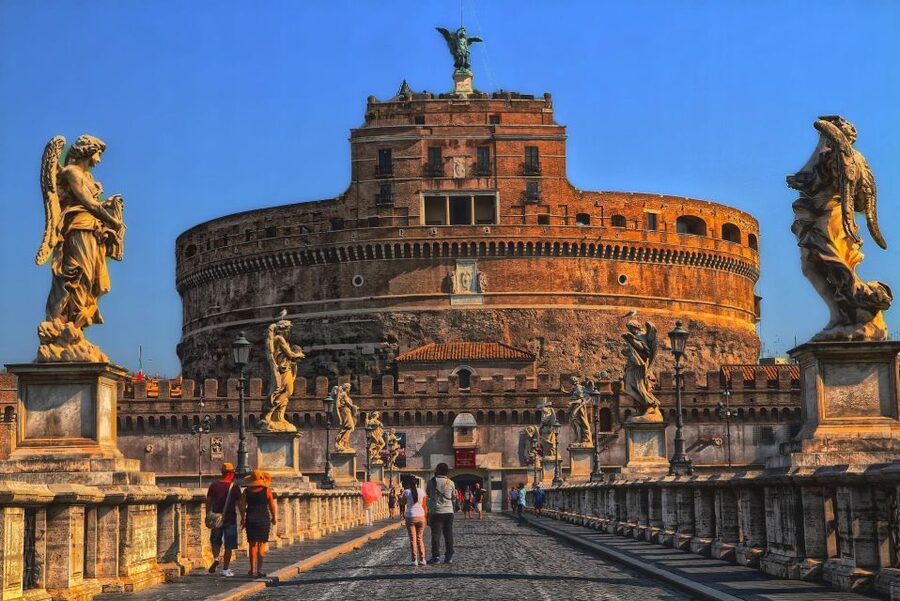
Rome’s best views come with stairs. Castel Sant’Angelo gives you fast entry, Hadrian’s ancient mausoleum, papal passageways, and a rooftop view across the Tiber. I especially like the freedom to explore at your own pace and the excellent phone audio guide, available in several languages. The main catch is that the ticket costs $20, while the official price is listed as €16, and the castle is not suitable for wheelchair users or people with mobility limits.
This is not a guided group walk with a fixed script. You receive a timed ticket by email or WhatsApp, download the audio app if you choose it, and make your way through the castle independently. Wear good shoes, bring headphones, and arrive on time. Late entry can mean losing the ticket.
In This Review
- Key points at a glance
- Why Castel Sant’Angelo is worth your time
- Getting inside with the timed ticket
- Hadrian’s tomb and the Roman core
- The papal corridors and defensive past
- The legend of the Archangel Michael
- Climbing to the terrace
- Choosing the audio guide or going without
- How long to allow
- Who should book this experience?
- Cancellation, timing, and value
- Should you book Castel Sant’Angelo?
- FAQ
- Where is Castel Sant’Angelo located?
- What is included in the ticket?
- Is the audio guide available in English?
- Do I need to meet a guide?
- When will I receive my ticket?
- Do I need to arrive at a specific time?
- What is the latest entry time?
- Do I need headphones?
- Is the castle wheelchair accessible?
- Can I bring luggage or a pet?
- Can I cancel for a refund?
Key points at a glance
- Hadrian’s tomb inside a fortress: See the core of the second-century Mausoleum of Hadrian, later reshaped for military and papal use.
- Skip the ticket queue: Show your reserved ticket at the scheduled time instead of waiting to buy entry on site.
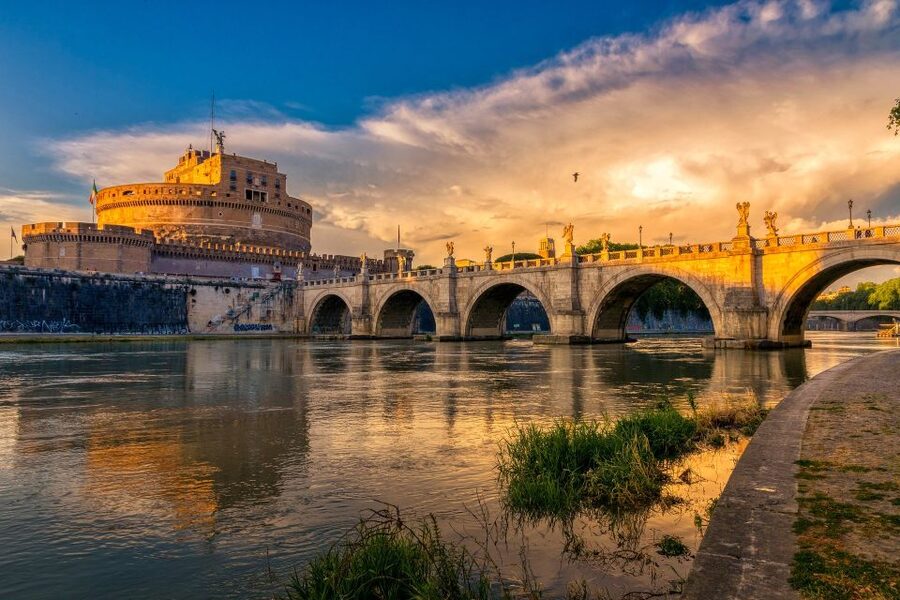
- Rome from the terrace: Climb to the top for broad views of the Tiber, Rome, Vatican City, and Ponte Sant’Angelo.
- Audio guide at your own pace: The app offers English, Italian, French, Spanish, German, and Chinese commentary.
- The castle takes time: You might spend two to four hours here if you read the displays, use the audio guide, and stop for the views.
- Plan for stairs and a light bag: Large bags, luggage, weapons, sharp objects, and pets are not allowed.
Why Castel Sant’Angelo is worth your time
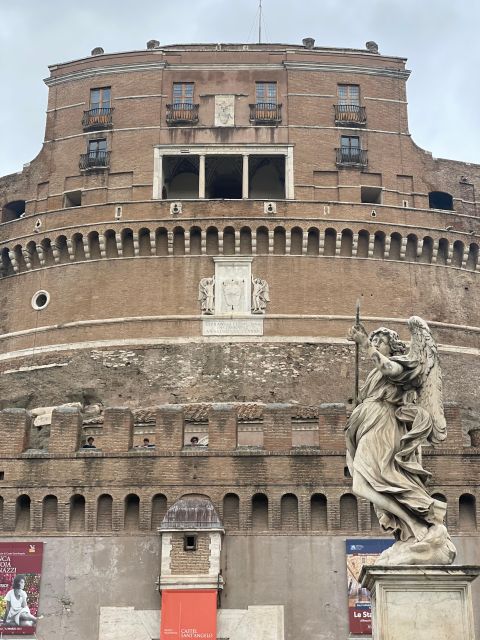
Castel Sant’Angelo is one of Rome’s most unusual monuments because it refuses to fit into one category. It began as the Mausoleum of Hadrian, a monumental tomb for the Roman emperor Hadrian and his family. Later, it became a fortress, a papal refuge, and a place of political power.
That changing role is what makes the visit so rewarding. You are not walking through a single-period museum. The building itself tells the story. Ancient Roman foundations sit beneath military defenses, decorated rooms, narrow routes, and papal corridors.
I like that the experience leaves room for curiosity. You can stop to read the information panels, listen to the app, or simply follow the route and let the building reveal itself. One visitor spent four hours here, while another found the audio guide useful because it allowed a leisurely visit. You can make this a quick ninety-minute stop, but the castle gives you reasons to stay longer.
The overall rating is 4.4 from about 3,500 ratings, and the praise is consistent in two areas: the views and the freedom to explore independently. Those are the strongest reasons to book.
A few more Rome bookings to compare
- Vatican: Museums & Sistine Chapel Entrance Ticket
★ 4.5 · 144,003 reviews - Vatican Museums & Sistine Chapel Tour with Optional Basilica
★ 4.3 · 67,413 reviews - Colosseum, Roman Forum & Palatine Guided Tour
★ 4.7 · 63,148 reviews
Getting inside with the timed ticket
There is no traditional meeting with a guide. Your entry ticket is sent electronically, usually by email or WhatsApp about 24 hours before the visit. You must download the audio app before arriving if you have selected that option.
At the entrance, the key thing is timing. Entry is allowed only at the scheduled time, and late arrivals may be refused without a refund. Do not treat the time as a loose suggestion. Build in enough time to reach the castle, find the entrance, and check your phone before the appointment.
The skip-the-line benefit depends on the day and season. In February, one visitor found no queue at all. On another morning, the ticket line reportedly snaked around the corridor, and reserved entry avoided a long wait in the heat. That is the real value here: you are paying for certainty as much as speed.
At $20 per person, this costs more than the stated official ticket price of €16. If you visit during a quiet period and find no line, the extra fee may feel unnecessary. If the queue is long, the convenience can easily justify the difference, especially on a hot day or when you have a tightly packed Rome schedule.
Hadrian’s tomb and the Roman core

The visit begins with the ancient purpose of the building. Hadrian’s Mausoleum, also called Hadrian’s Mole, was built as an enormous imperial tomb. The structure’s size is hard to miss, even before you understand the later additions.
You can think of the castle in layers. At the center is the Roman monument. Around and above it are centuries of changes that turned a tomb into a defensive stronghold and then a papal residence. This is why the building feels more like a route through time than a simple collection of rooms.
The interior includes artwork, architecture, information panels, and views from several levels. You might be surprised by how much there is to see inside. The castle can look stern and plain from outside, but the rooms and details become more interesting as you move upward.
The audio guide helps connect those pieces. It is not compulsory, and several people enjoyed exploring without it. I would choose the audio option if you want historical context without joining a group, especially if this is your first visit and you want to understand why the building changed so much.
The papal corridors and defensive past

Castel Sant’Angelo’s connection to the Vatican is one of its most compelling features. The castle sits on the right bank of the Tiber, a short distance from Vatican City, and its protected routes helped link the fortress with papal territory.
The papal corridors give the monument a different mood from the ancient tomb. You move from imperial Rome into the world of popes, fortifications, political danger, and emergency refuge. The exact route and access can change, especially during the Jubilee period, when restoration work may affect some monuments and paths. Check your messages before your visit for updates.
The castle is best appreciated slowly here. Follow the signs so you do not miss sections, but pause when a room or passage catches your attention. The independent format works well because you are not being pushed along by a group.
There is a practical tradeoff. Without a live guide, you must manage your own orientation and decide how much context you want. The audio app fills much of that gap, but it depends on your phone, battery, and headphones. Bring a charged smartphone and download the app in advance, rather than trying to solve technical problems at the entrance.
Still Rome, but a slower afternoon:
- Vatican Museums, Sistine Chapel & St Peter’s Basilica Guided Tour
★ 4.5 · 39,149 reviews - Rome: Colosseum, Palatine Hill and Roman Forum Guided Tour
★ 4.8 · 32,814 reviews - Rome: Guided Tour of Colosseum, Roman Forum & Palatine Hill
★ 4.7 · 27,897 reviews - Rome: Colosseum & Forum with Audio Guide App -Optional Arena
★ 4.2 · 24,770 reviews
The legend of the Archangel Michael
The castle’s current name comes from a famous legend connected to the plague of 590. According to the story, the Archangel Michael appeared above the mausoleum and sheathed his sword, signaling that the plague was ending.
A statue of the archangel now crowns the castle, making the legend visible from a distance. The story also explains why this former imperial tomb became known as Castel Sant’Angelo, or Castle of the Holy Angel.
This is a good moment to use the audio guide. A short explanation can make the name, statue, and later Christian identity of the building click into place. Without that context, you may simply see a fortress with an angel on top. With it, the castle’s transformation becomes easier to follow.
The audio guide is available in English, Italian, French, Spanish, German, and Chinese. It comes through a smartphone app, and the download needs about 100 to 150 MB of free space. It works with Android 5.0 or later and supported iPhones, but older devices are not compatible, including iPhone 5, iPhone 5C, earlier models, older iPod Touch devices, and older iPads.
Climbing to the terrace
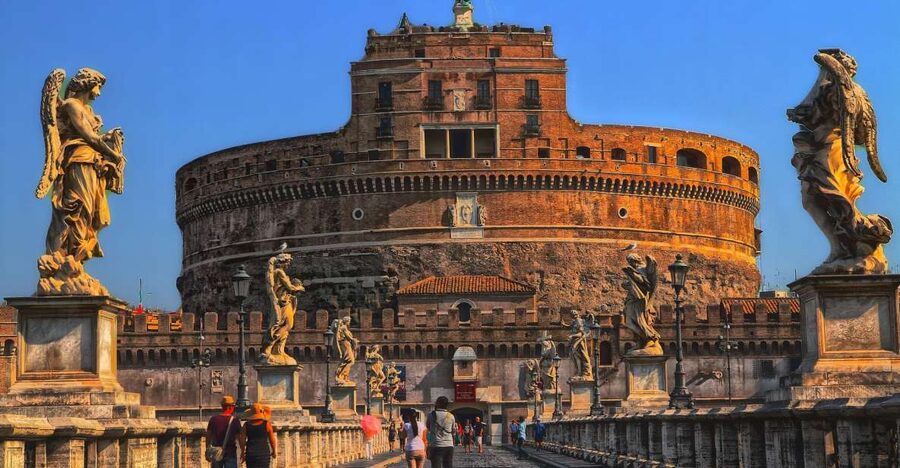
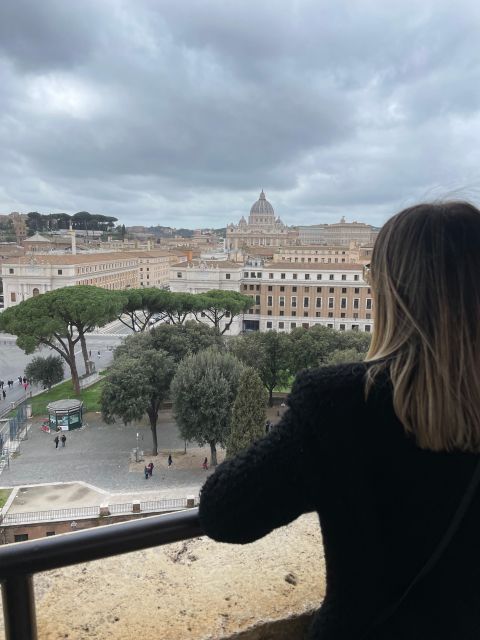
The high point of the visit is the panoramic terrace. You reach it by climbing stairs, so this part requires a reasonable level of mobility. The effort pays off with open views across Rome and along the Tiber.
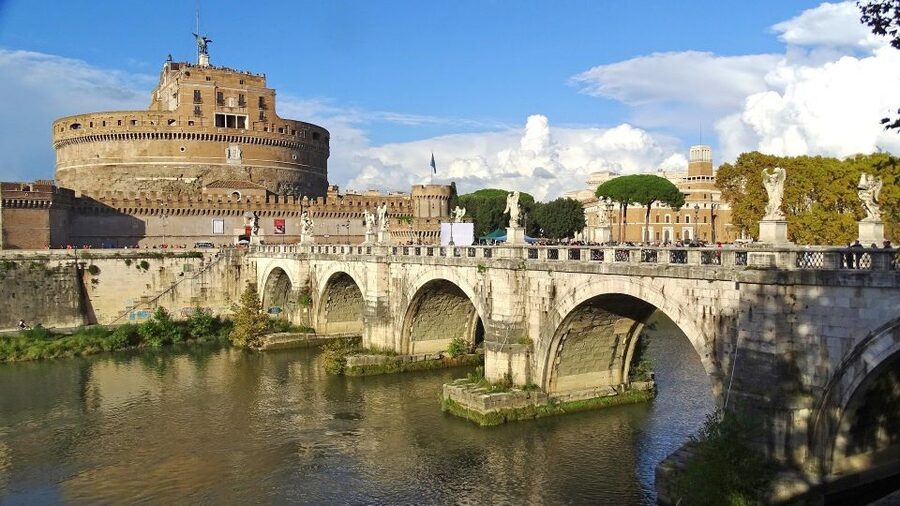
From above, you can photograph Ponte Sant’Angelo, also called the Bridge of Angels. The bridge gives you a particularly strong view back toward the castle, while the terrace opens the city in several directions. Vatican City is also visible, and the elevated position makes this a useful place to understand how the castle relates to the river and nearby landmarks.
The view is not a minor extra. It is one of the main reasons people remember the visit. Several ratings specifically praise the panorama from the top, and one person described the views as the best in Rome. That is subjective, of course, but the terrace is plainly a highlight.
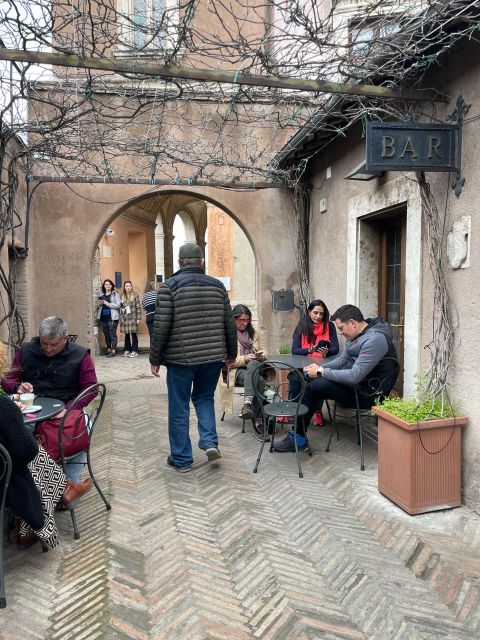
There is also a café partway up, with views toward Vatican City. It can be a pleasant pause if you want a drink or something to eat, though the rooftop restaurant may be busy. Treat it as a bonus, not the reason to buy the ticket.
Bring comfortable shoes. The floors and stairways are part of the old building, and the route upward is not suitable for wheelchair users or people with mobility impairments. Large bags and luggage are not allowed, so pack light.
Choosing the audio guide or going without
The optional audio guide is one of the better features of this ticket. It gives you a self-guided visit without requiring you to match the pace of a group. You can stop the commentary, reread a panel, take photographs, or move ahead when you are ready.
The app also includes text, which helps if you prefer reading or do not want to wear headphones continuously. Still, headphones are not included, so bring your own. Using the phone speaker in crowded indoor spaces would be less comfortable for you and for others.
I would select the audio guide if you want a clear narrative about Hadrian, the plague legend, the papal corridors, and the building’s military role. I would skip it if you enjoy reading on-site panels and prefer to look closely at the architecture without handling your phone.
The audio is not a substitute for a private historian. One highly praised visit included a live guide named Dimosthenis, whose archaeology background and extra material added a great deal of context. That is a different type of experience from this self-guided ticket. Choose this option for independence and flexibility, not for personal conversation or specialist questions.
How long to allow
The ticket is valid for one day, but entry is tied to a scheduled time. The last entry is at 6:30 PM. Check the available start times when booking, then allow enough time to climb, read, listen, and stop for photographs.
A fast visit could focus on the main rooms and terrace. I would allow at least two hours if you want the experience to feel unhurried. Three or four hours is reasonable if you use every audio section, read much of the information, pause at the café, and take your time with the views.
Early morning can be useful for lighter crowds. One early visit had almost no people inside at first, although the castle became busier as the morning went on. If you want a quieter start, choose the earliest suitable time rather than arriving late in the day.
Weather does not necessarily ruin the visit. Rain can make the terrace less comfortable, but the interior rooms and architecture still give you plenty to see. On a clear day, the rooftop is the natural finish.
Who should book this experience?

I would recommend it to you if you enjoy historic buildings that changed purpose over many centuries. It is also a good fit if you want a flexible visit near Vatican City and do not want to join a fixed group.
Families with older children may appreciate the fortress feel, the legend of the archangel, and the views. Independent sightseers will like being able to wander at their own pace. The multilingual audio option also makes the visit easier for people who prefer not to rely on English signage.
I would be more cautious if you have difficulty with stairs, need wheelchair access, or are carrying luggage. The terrace requires climbing, and large bags are not permitted. I would also think twice about paying the premium in a quiet low-season period if you are certain there will be no queue.
Bring these essentials:
- Your passport or ID card
- A charged smartphone
- Headphones
- Comfortable shoes
- Enough phone storage for the 100 to 150 MB audio download
Do not bring pets, weapons, sharp objects, luggage, or large bags.
Cancellation, timing, and value
You can cancel up to 24 hours before the activity for a full refund. That gives you some protection if your Rome plans change, but the rule does not help if you miss the timed entry itself.
The $20 price is fair when the queue is long, your schedule is tight, or you want the convenience of electronic entry and an optional audio guide. It is less compelling when the castle is quiet and the official €16 price is close to what you would otherwise pay.
The strongest value comes from combining three things: reserved entry, self-guided flexibility, and the terrace views. If you only want to walk around the building for a short time, you may not need the audio guide. If you want the castle to make sense as more than a photogenic fortress, the audio upgrade is worth considering.
Should you book Castel Sant’Angelo?
Yes, if you want a flexible visit to one of Rome’s most layered monuments, especially during a busy period. The rooftop panorama, Ponte Sant’Angelo photographs, Hadrian’s tomb, papal connections, and Archangel Michael legend give the visit real variety.
Book it with realistic expectations. This is an independent entry ticket, not a live guided tour. You must manage the app, arrive on time, and climb stairs. For many people, that freedom is the point. For others, a guide such as Dimosthenis would provide more personal historical detail.
Choose the audio guide if context matters to you. Skip it if you prefer printed information and your own wandering. Either way, Castel Sant’Angelo is worth adding to a Rome plan, and the skip-the-line option becomes especially useful when the ticket queue stretches beyond the entrance.
FAQ
Where is Castel Sant’Angelo located?
It is on the right bank of the Tiber in Rome, a short distance from Vatican City.
What is included in the ticket?
The experience includes a reserved skip-the-line entry ticket. A smartphone audio guide is included only if you select that option.
Is the audio guide available in English?
Yes. The audio guide is available in English, Italian, French, Spanish, German, and Chinese.
Do I need to meet a guide?
No. You do not need to meet anyone. Your entry tickets are sent electronically before the visit.
When will I receive my ticket?
Tickets are sent to your email or WhatsApp about 24 hours before the activity, usually by the late afternoon of the day before the entry date.
Do I need to arrive at a specific time?
Yes. Entry is allowed only at the scheduled time. Late arrivals may be denied access without a refund.
What is the latest entry time?
The last entry to Castel Sant’Angelo is at 6:30 PM.
Do I need headphones?
Yes, bring your own headphones if you select the audio guide. Headphones are not included.
Is the castle wheelchair accessible?
The experience is not suitable for wheelchair users or people with mobility impairments. You need to climb stairs to reach the panoramic terrace.
Can I bring luggage or a pet?
No. Pets, weapons, sharp objects, luggage, and large bags are not allowed.
Can I cancel for a refund?
Yes. You can cancel up to 24 hours in advance for a full refund.
Recently added around Rome
- Palatine Hill and Roman Forum Tour with Fast-Track Entrance★ 4.2 · 417 reviews
- Tivoli: Villa D’Este & Villa Adriana Pass & App Audioguide★ 4.4 · 364 reviews
- From Rome: Villa D’Este & Villa Adriana Day Trip with Lunch★ 4.4 · 289 reviews
- Vatican Museums & Sistine Chapel Skip-the-Line Guided Tour★ 4.6 · 254 reviews
- Rome: The Three Tenors at St. Paul’s Church Concert Ticket★ 4.7 · 699 reviews
- Tivoli: Villa D’Este Entry Ticket and App Audio Guide★ 4.3 · 191 reviews
- Rome: Capitoline Museums and Centrale Montemartini Tickets★ 4.4 · 328 reviews
- Rome: St. Peter’s Basilica and Papal Tombs Guided Tour★ 4.6 · 477 reviews
Skip the Line, compared.
Skip-The-Line Uffizi Gallery Timed Entry Ticket
Read our review →
Vatican Museums & Sistine Chapel Skip-the-Line Entry Ticket
Read our review →
Skip-the-Line Group Tour of the Vatican, Sistine Chapel & St. Peter’s Basilica
Read our review →
Michelangelo’s David Skip-the-Line Entry Ticket
Read our review →
Vatican Museums & Sistine Chapel Skip-The-Line Ticket
Read our review →
Vatican, Sistine Chapel & St. Peter’s Skip-the-Line Tour
Read our review →
Skip-the-Line Vatican, Sistine Chapel & St. Peter’s | Small Group
Read our review →
Vatican Museums Sistine Chapel Skip-the-Line Ticket
Read our review →Browse the lists this tour appears in