Reviewed · PRIVATE
Rome: Caracalla Baths & Circus Maximus — Private or Shared
Ancient Rome’s leisure life was more than gladiators. This 90-minute tour pairs the enormous Baths of Caracalla with the former Circus Maximus, giving you a close look at how Romans relaxed, exercised, socialized, and watched public games. I especially like the small-group format, capped at 10 people, and the way guides such as Chiara, Lars, Francesca, Mario, and Samuele have made the ruins easier to picture.
I also like that the tour takes you to a quieter archaeological area near the Colosseum, rather than keeping you in Rome’s busiest visitor corridors. The main caution is simple: the Baths of Caracalla are the star, while Circus Maximus is mostly an open site where your guide and your imagination do much of the work.
In This Review
- Key points at a glance
- Why the Baths of Caracalla deserve your time
- The one-hour Baths visit
- How Roman bath technology comes to life
- Walking to Circus Maximus
- Why Circus Maximus can feel underwhelming
- Guides are the deciding factor
- Is $77 a fair price?
- Meeting point, access, and what to bring
- Who should book this Rome tour?
- Should you book it?
- FAQ
- How long does the tour last?
- Where do I meet the guide?
- How early should I arrive?
- Is admission to the Baths of Caracalla included?
- Is a guide included?
- What languages are available?
- Can I book a private tour?
- Is the tour wheelchair accessible?
- Can I cancel for a refund?
Key points at a glance
- The Baths take about an hour: You see enormous walls, mosaics, monumental rooms, and the remains of the heating system.
- Circus Maximus takes 30 minutes: The site is historically important, but relatively little survives above ground.
- Groups stay small: The maximum is 10 participants, with private and semi-private options available.
- Guides receive the highest praise: Chiara, Lars, Francesca, Mario, Samuele, Anestis, and others are singled out for clear explanations and lively storytelling.
- The meeting point is easy to reach: Meet outside Circo Massimo Metro Station, near the FAO building.
- The $77 price needs context: It is worthwhile if you want expert interpretation and a focused visit, but less attractive if you mainly want access to the ruins.
Why the Baths of Caracalla deserve your time
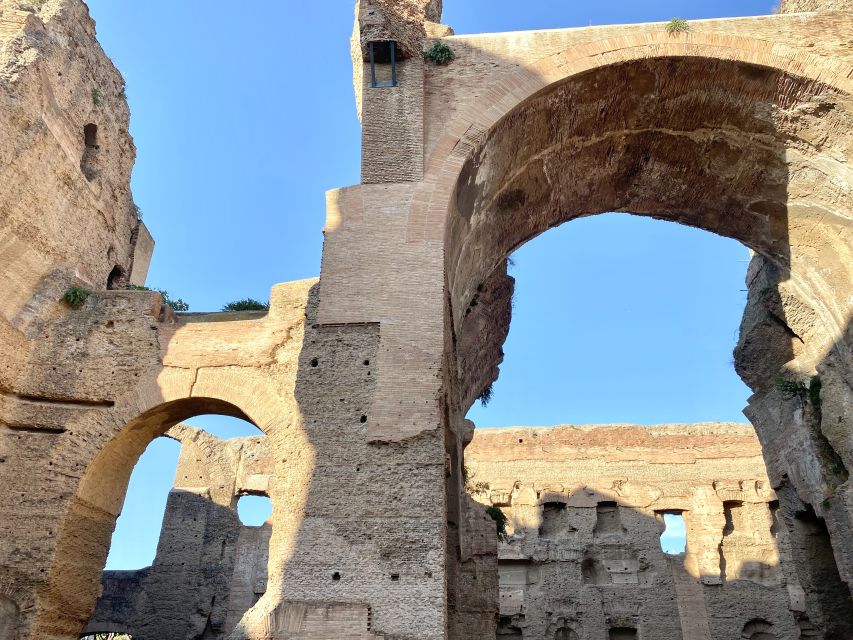
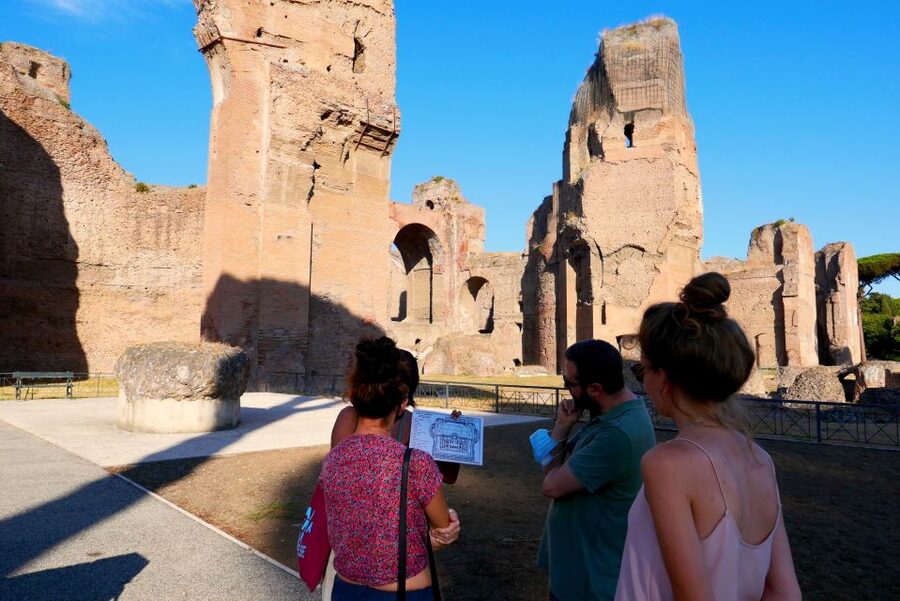
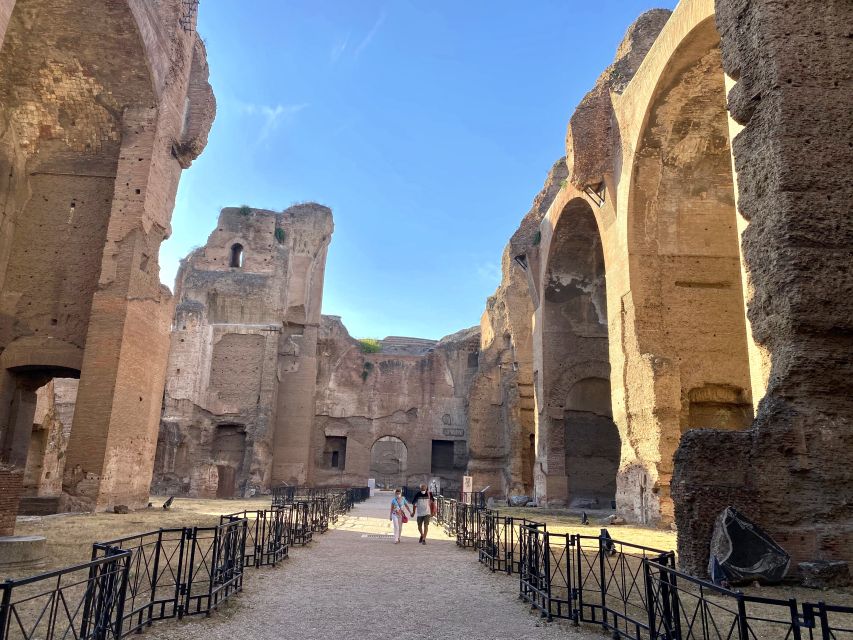
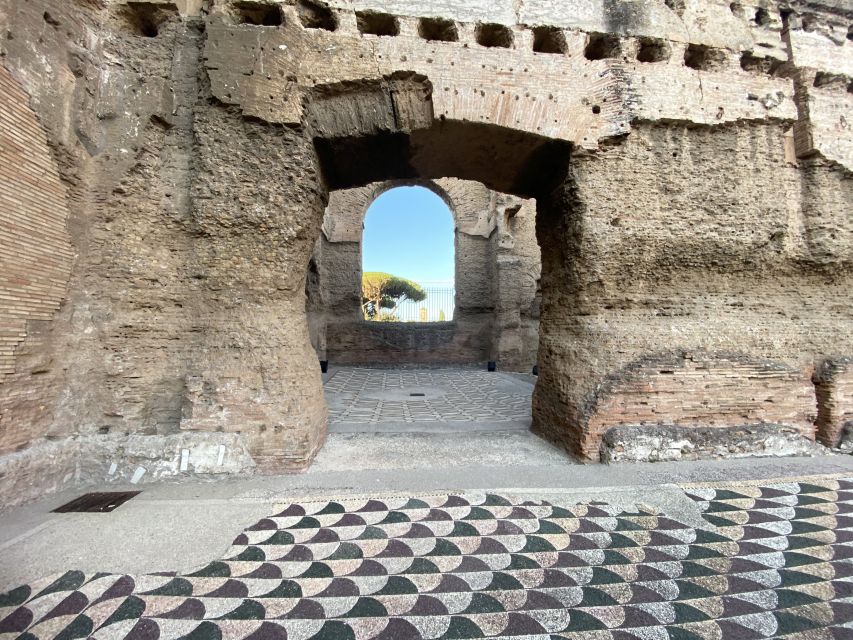
The Baths of Caracalla are among the most impressive Roman ruins in Rome, partly because their scale is still easy to grasp. Even in a ruined state, the surviving walls are huge. You can walk through the remains of rooms that once formed one of the ancient world’s grandest public bathing complexes.
I find the site especially useful for understanding Roman life beyond emperors and warfare. These baths were not simply places to wash. Your guide explains how a typical visit in the third century AD could involve bathing, exercise, conversation, and time spent caring for both body and mind.
The tour follows the imagined sequence of a Roman visit. That approach gives the broken masonry a purpose. Instead of seeing disconnected walls, you begin to understand how the rooms worked together and why the complex needed so much space.
The Baths of Caracalla are also a strong lesson in Roman engineering. The guide explains the underfloor heating system, including how workers maintained different temperatures in separate rooms. This is one of the most useful parts of the visit because the technology is easy to miss if you explore alone.
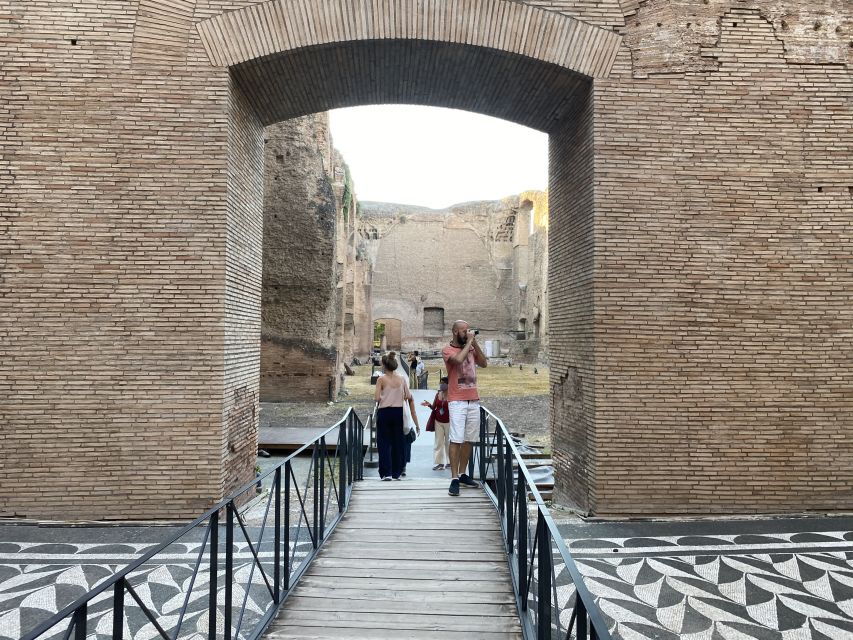
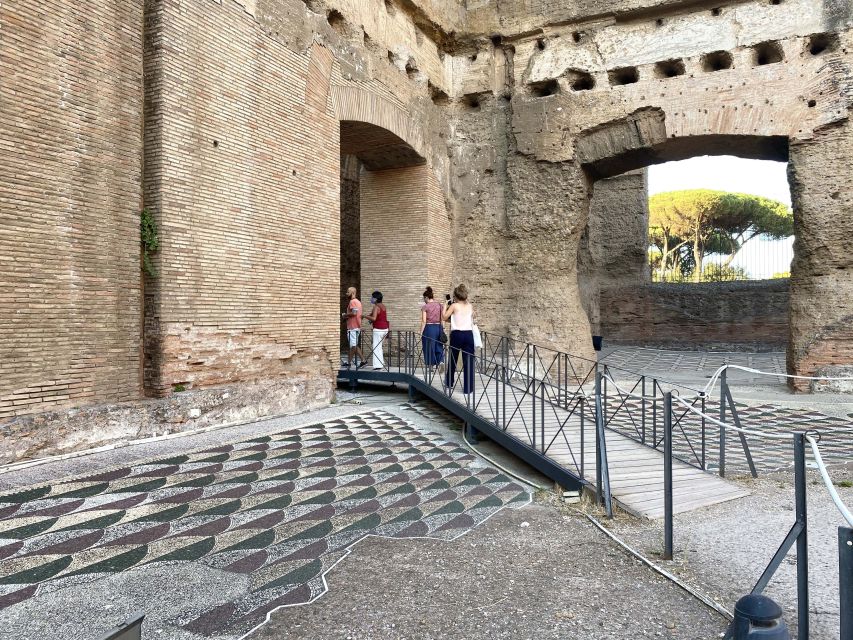
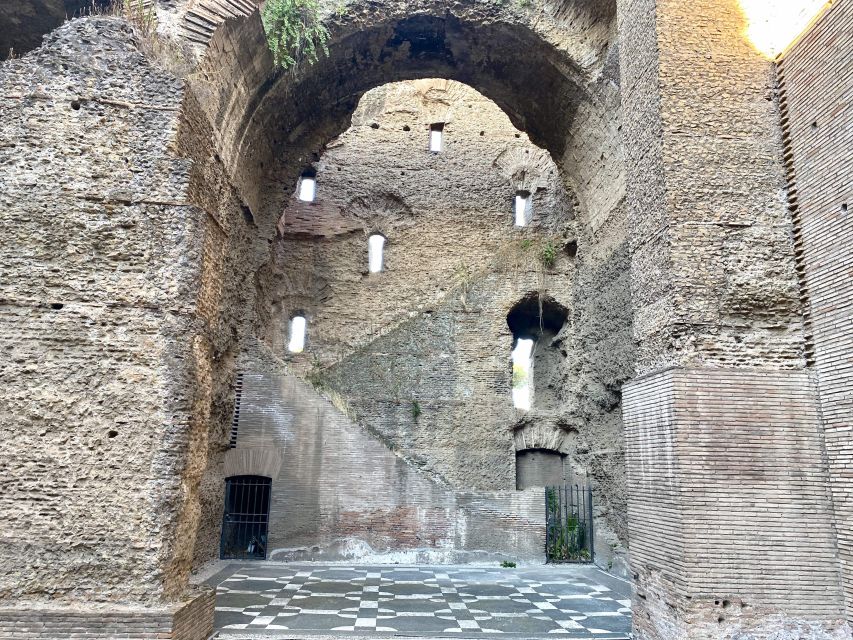
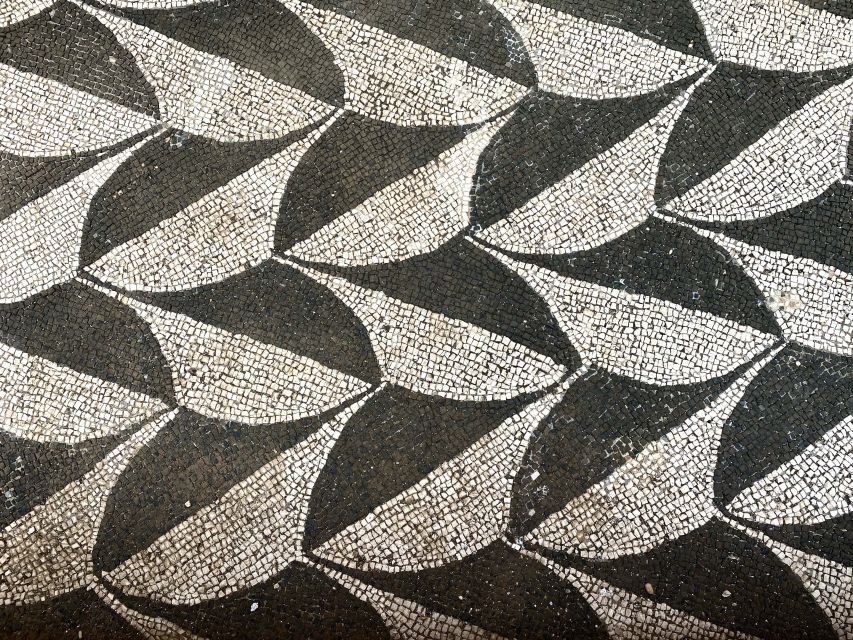
You also get time to look at the geometric mosaics that remain across parts of the complex. Some floors and decorative details have survived with surprising clarity. The mosaics help you picture how polished and carefully designed the baths were before centuries of decay and stone removal changed the site.
Several guides have been praised for making these details understandable without turning the visit into a dry lecture. Anestis was especially effective at bringing the ruins to life through clear explanations of the architecture. Chiara has been praised for combining archaeological detail with warmth and humor, while Mario is remembered for making the ancient bathing routine feel almost present again.
A few more Rome bookings to compare
- Vatican: Museums & Sistine Chapel Entrance Ticket
★ 4.5 · 144,003 reviews - Vatican Museums & Sistine Chapel Tour with Optional Basilica
★ 4.3 · 67,413 reviews - Colosseum, Roman Forum & Palatine Guided Tour
★ 4.7 · 63,148 reviews
The one-hour Baths visit
The first hour is spent inside the Baths of Caracalla. You should expect steady walking over an archaeological site, so comfortable shoes matter. The tour is wheelchair accessible, but the site remains a monumental ruin rather than a polished indoor museum.
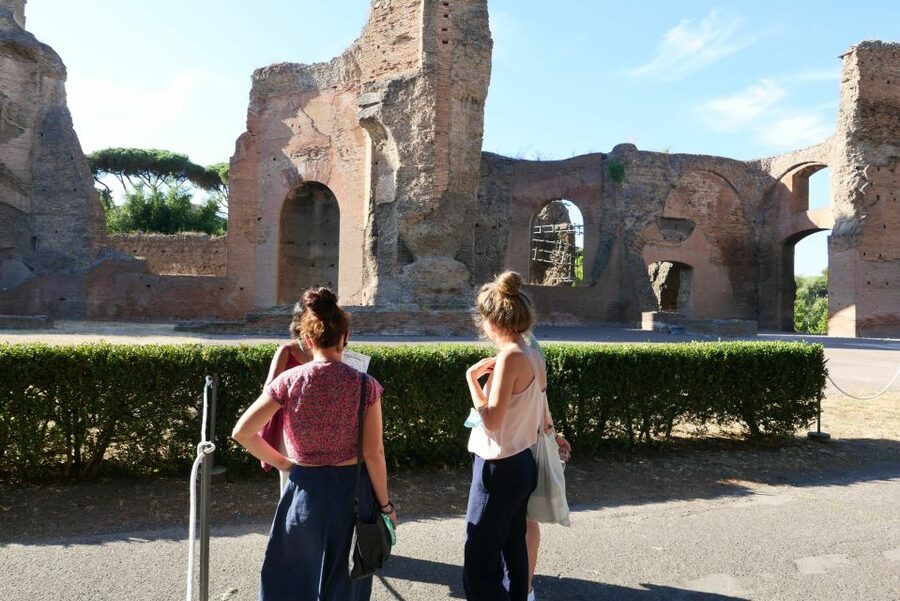
Your guide points out the huge walls and the principal rooms, then explains what once occupied the spaces. The size is the first thing that hits you. The complex was built for public use on a vast scale, and even partial walls give you a sense of the ambition behind it.
The guide also draws attention to the mosaics and other surviving decorative features. This is where the supplied headsets help. The equipment lets you hear the guide clearly while standing in a large open area, and it means you do not need to crowd around the speaker.
I would allow yourself time to look up and around, not just at the guide. The height of the surviving structures is one of the most memorable parts of the visit. A detailed explanation is useful, but the architecture also needs a quiet moment to sink in.
The hour is described as an express visit, so the pace is purposeful. That works well if you have only a few days in Rome or want to fit the Baths between other sights. It may feel quick if you prefer to linger over every mosaic, photograph every wall, or read every available sign.
The tour can sometimes become private in practice if few people book a particular language or departure. Several visitors received a private-style visit without paying more, and one small-group booking turned into a private tour. That is not something you should count on, but the maximum group size of 10 still keeps the format personal.
How Roman bath technology comes to life
The Baths are rewarding because the guide explains the systems hidden beneath the decoration. The underfloor heating, known as a hypocaust system, required substantial labor and careful control. You learn how heat moved below the floors and how different rooms could be kept at different temperatures.
You also hear about the range of services offered at the baths. The point is not just that Romans had an early version of a spa. The complex served as a social and physical center, with activities aimed at both the body and the mind.
That wider picture helps explain why the baths were so important. Public bathing was part of urban life, and a complex on this scale required architecture, fuel, water, staff, maintenance, and organization. The guide connects the visible ruins with the less visible work needed to operate them.
This is where a live archaeologist guide is worth paying for. A solo visit can show you walls and floors, but it is much harder to understand why the rooms were arranged as they were or how the heating worked. The strongest guides do not just list dates. They help you read the building.
Walking to Circus Maximus
After the Baths, the tour continues to Circus Maximus. The exact route is not specified, but the meeting point and the two sites are in the same broad archaeological area near the Colosseum. Your guide may also use the walk to point out surrounding buildings and monuments, as one guide did during the visit.
Circus Maximus was considered the largest structure ever built for public games. It was the setting for Roman Ludi, large public celebrations that could continue for several days and include more than one type of event.
The site is tied most closely to chariot racing, but your guide also discusses gladiator contests and the noise of the crowd. You stand on ground associated with those events, then hear how the circus fit into Roman public life and older stories about Rome’s origins.
The connection to early Roman myths adds another layer. The circus was linked to a quasi-legendary period before Rome became the imperial city known from history books. Your guide explains its associations with early gods and foundation stories, giving the site a place in Rome’s larger story.
Still Rome, but a slower afternoon:
- Vatican Museums, Sistine Chapel & St Peter’s Basilica Guided Tour
★ 4.5 · 39,149 reviews - Rome: Colosseum, Palatine Hill and Roman Forum Guided Tour
★ 4.8 · 32,814 reviews - Rome: Guided Tour of Colosseum, Roman Forum & Palatine Hill
★ 4.7 · 27,897 reviews - Rome: Colosseum & Forum with Audio Guide App -Optional Arena
★ 4.2 · 24,770 reviews
Why Circus Maximus can feel underwhelming
This is the part of the tour to approach with the right expectations. Circus Maximus is historically enormous, but the present-day site does not offer the same amount of visible ancient fabric as the Baths of Caracalla.
One visitor put it plainly: there is not much to see at Circus Maximus. Another said the site leaves much to the imagination. That criticism is fair. You will not find a complete stadium rising around you in the way the Colosseum creates an immediate picture of ancient spectacle.
Instead, the value lies in location, scale, and explanation. The open space gives you a sense of how large the venue once was, while the guide supplies the missing details about races, celebrations, and crowds. If you enjoy historical reconstruction, you may find this fascinating. If you want dramatic ruins at every stop, the second half could feel thin.
I would treat Circus Maximus as a useful companion to the Baths rather than the main reason to book. The Baths provide the physical evidence. Circus Maximus provides the setting and story.
Guides are the deciding factor
The strongest part of this tour is the guide. The recorded feedback gives repeated praise to guides who combine clear historical explanations with an easy, friendly manner.
Chiara has been praised for being warm, entertaining, and deeply informed. Francesca is remembered for answering questions and keeping the visit enjoyable. Lars has received praise for his English, personal approach, and ability to answer detailed questions. Mario and Samuele are noted for their enthusiasm and broad knowledge of Rome beyond the main subject.
That variety matters because a site like the Baths can be difficult to understand without interpretation. A good guide tells you what you are seeing, but also why it matters. The best tours here seem to include room for questions, especially when the group is small.
Several visits also ran longer than the advertised 90 minutes. One private-style tour lasted two and a half hours, while another was extended by half an hour because the guide was so engaged with the subject. These longer visits should be viewed as pleasant surprises, not a promise. Your booked duration remains 1.5 hours.
The guide may also offer useful Rome advice beyond the ruins. One visitor appreciated getting suggestions for later activities from a Rome native. That can be handy early in a trip, though the tour itself remains focused on the Baths and Circus Maximus.
Is $77 a fair price?
At $77 per person, this is not the cheapest way to see the Baths. The fee includes entry to the Caracalla complex, a live archaeologist guide, headsets, and on-site assistance. It does not include food, drinks, or transport to and from your hotel.
The value depends on how you like to visit ancient sites. If you are happy reading signs and using your own guidebook, the price may feel high, especially since Circus Maximus has limited visible remains. One visitor specifically felt the cost was steep compared with longer or broader Rome activities.
I think the price makes more sense for first-time visitors who want a focused explanation without spending half a day at a major attraction. It also works well for families, couples, and anyone who prefers asking questions instead of following a large crowd.
The small group limit helps. A group of eight or fewer is comfortable for walking and conversation, while a private booking gives you more control over pace. Private, semi-private, and shared options let you decide how much personal attention you want.
You also get free cancellation up to 24 hours before the start time and can reserve now while paying later. That flexibility is useful when your Rome schedule depends on weather, train arrivals, or other timed visits.
Meeting point, access, and what to bring
Meet at the exit of Circo Massimo Metro Station in the direction of Laurentina, in front of the FAO building. Look for a yellow sign with the local partner’s name. Arrive at least five minutes early so the sign-up process does not delay the group.
Wear comfortable walking shoes. The tour lasts only 90 minutes, but you will be walking through an archaeological complex and moving between sites.
Large bags, trolleys, and large backpacks are not permitted inside the monuments. Baby strollers, pets, drones, weapons, and sharp objects are also prohibited. There is no hotel pickup or drop-off.
The tour is wheelchair accessible. Bad weather can cause cancellation, in which case you are offered another date or a full refund. Participants under 18 and European citizens under 25 must carry official identification, or a digital copy.
Tours are offered in English, Italian, French, Portuguese, Spanish, and German. Check the available departure time and language before booking.
Who should book this Rome tour?
I would recommend it to you if you want a quieter archaeological visit close to the Colosseum, especially if the idea of understanding Roman daily life appeals to you more than simply checking off famous monuments.
It suits families because the guide can explain the heating, mosaics, bathing routine, and public games in a way that gives children something concrete to notice. It is also a good choice for couples and small groups who want a more relaxed alternative to the Colosseum crowds.
You should think twice if Circus Maximus is your main interest. The guide can tell you a great deal, but the physical remains are modest. If your schedule is tight, you might prefer a visit centered only on the Baths, if that option is available.
Should you book it?
Book this tour if you want the Caracalla Baths explained properly, with an archaeologist guide, a small group, and a clear account of Roman engineering and leisure. The Baths are the real prize, and the expert storytelling turns an impressive ruin into a place you can understand.
Book with more caution if you expect two equally dramatic monuments. Circus Maximus is mainly an atmospheric historical setting, not a preserved arena. At $77, the tour earns its price through the guide, the entrance fee, and the small-group attention. For many visitors, that will be worthwhile. For independent sightseers on a strict budget, the Baths alone may offer better value.
FAQ
How long does the tour last?
The scheduled duration is 1.5 hours. The itinerary allows about one hour at the Baths of Caracalla and 30 minutes at Circus Maximus.
Where do I meet the guide?
Meet at the exit of Circo Massimo Metro Station, in the direction of Laurentina, in front of the FAO building. Look for a yellow label with the local partner’s name.
How early should I arrive?
You should arrive five minutes before the scheduled starting time to complete the sign-up process.
Is admission to the Baths of Caracalla included?
Yes. The entrance fee to the Caracalla Baths is included.
Is a guide included?
Yes. The tour includes a live archaeologist guide and sterilized headsets so you can hear the explanations clearly.
What languages are available?
Tours are available in French, Portuguese, Spanish, English, German, and Italian.
Can I book a private tour?
Yes. Private and small-group options are available. Shared tours have a maximum of 10 participants.
Is the tour wheelchair accessible?
Yes, the activity is listed as wheelchair accessible.
Can I cancel for a refund?
You can cancel up to 24 hours in advance for a full refund. The tour may also be canceled because of unfavorable weather, with an alternative date or full refund offered.
Recently added around Rome
- Palatine Hill and Roman Forum Tour with Fast-Track Entrance★ 4.2 · 417 reviews
- Tivoli: Villa D’Este & Villa Adriana Pass & App Audioguide★ 4.4 · 364 reviews
- From Rome: Villa D’Este & Villa Adriana Day Trip with Lunch★ 4.4 · 289 reviews
- Vatican Museums & Sistine Chapel Skip-the-Line Guided Tour★ 4.6 · 254 reviews
- Rome: The Three Tenors at St. Paul’s Church Concert Ticket★ 4.7 · 699 reviews
- Tivoli: Villa D’Este Entry Ticket and App Audio Guide★ 4.3 · 191 reviews
- Rome: Capitoline Museums and Centrale Montemartini Tickets★ 4.4 · 328 reviews
- Rome: St. Peter’s Basilica and Papal Tombs Guided Tour★ 4.6 · 477 reviews
Private, compared.

Como & Bellagio with Private Lake Como Cruise
Read our review →
Murano & Burano Islands Guided Small-Group Tour by Private Boat
Read our review →
Rome by Golf Cart Private Tour: Beyond the Landmarks
Read our review →
Early Morning Vatican, Sistine, St. Peter’s Semi or Private Tour
Read our review →
Private 3 hrs Venice Tour: St Mark’s, Walking tour & Boat tour
Read our review →
Private Gondola Cruise for up to 5 Passengers
Read our review →