Reviewed · FLORENCE TOURS
Perfume Masterclass in Florence: Make your Own Personal Fragrance
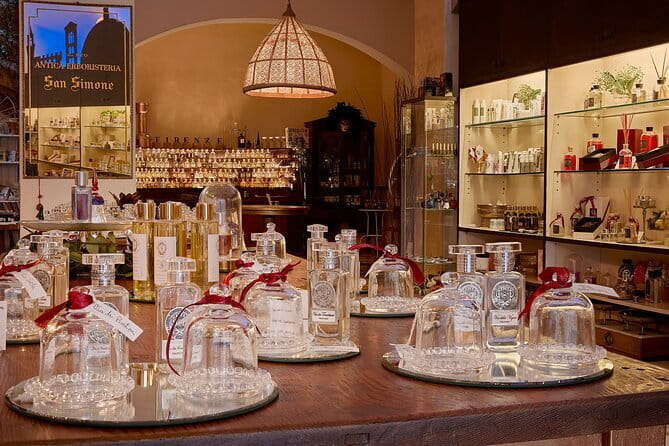
Scent can be the best souvenir. This two-hour Florence workshop takes you into Antica Erboristeria San Simone, an atmospheric 1700s apothecary where you choose fragrance notes, work with a master perfumer, and leave with a 30ml bottle of your own perfume. I like the setting and the personal result: you are not simply buying a bottle off a shelf, you are helping shape one. The main caution is that this is a guided blending session, not a full perfumery course with unlimited ingredients.
I also like the relaxed pace, the small-group format, and the chance to reorder your formula later. Coffee, tea, or water is included, along with a signed certificate. Still, you should arrive on time and keep your expectations in check: some sessions offer only a limited selection of scent vials, and the amount of historical explanation can vary.
In This Review
- Key points at a glance
- Entering Florence’s old apothecary
- The Florentine story behind the scents
- Choosing from the fragrance kit
- Mixing and bottling your signature scent
- The coffee break and signed certificate
- Is $84.69 a fair price?
- Group size, language, and timing
- Who will enjoy this Florence activity?
- Practical tips for a better result
- Should you book the perfume masterclass?
- FAQ
- Where does the perfume masterclass take place?
- How long does the perfume class last?
- What do I take home?
- Is the class offered in English?
- How many people can join the class?
- Is transportation included?
- Is a drink included?
- Can I cancel for a refund?
Key points at a glance
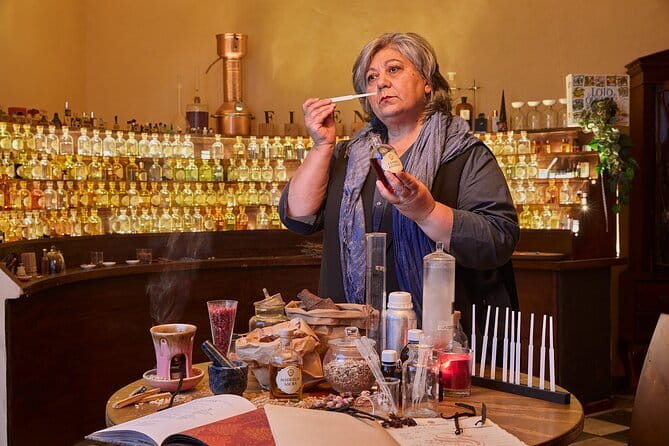
- A real 1700s apothecary setting: The class takes place at Antica Erboristeria San Simone, with old glassware, ampules, dried herbs, and rare essences around you.
- Your own 30ml fragrance: You select notes you enjoy, and the perfumer combines them into a personal bottle for you to take home.
- A gentle introduction to perfume structure: You learn about top, heart, and base notes and how they work together.
- A compact two-hour activity: It fits neatly into a Florence sightseeing day, with a complimentary coffee, tea, or water break.
- A small group, but not always a private class: The maximum is 15 people, so the atmosphere can feel personal, though larger sessions may involve some waiting.
- Best for curious beginners: It suits couples, families with older children, friends, solo visitors, and anyone who wants a creative Florence souvenir.
Entering Florence’s old apothecary
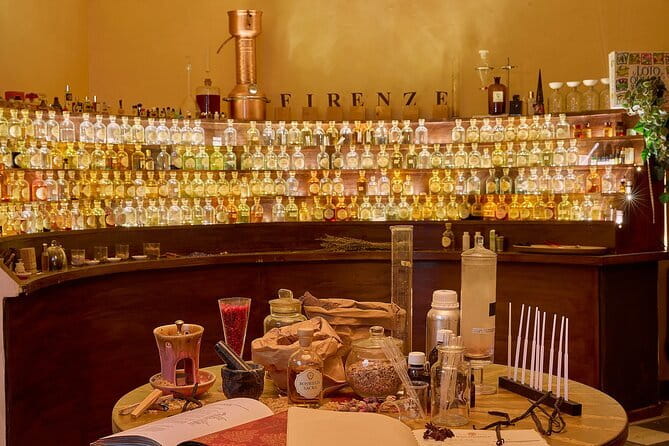
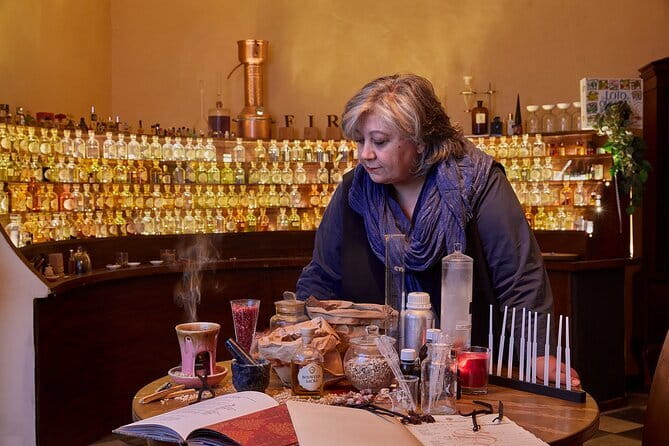
The meeting point is Via Ghibellina 190, a central Florence address near public transportation. You meet the master perfumer there, then enter Antica Erboristeria San Simone, the shop and artisanal laboratory that host the activity.
The room is a major part of the appeal. You are surrounded by the kind of glass bottles, ampules, herbs, and old-world tools that make perfume feel connected to alchemy and pharmacy. This is not a modern classroom stripped of character. The surroundings help explain why Florence has long been linked with botanical preparations, scented products, and courtly fragrance.
The setting is also a good reason to arrive early. One participant arrived only a few minutes after the stated start and found that the class had already begun. I would aim to be there 10 to 15 minutes before the scheduled time, especially if you are walking from another part of the city.
Take time to look around the shop before or after the class. The owners’ collection of perfume and the store’s displays add context that may not fit into the formal instruction. If you care about the Florentine side of the experience, this quiet browsing time can be as useful as the first talk.
A few more Florence bookings to compare
- Florence: Skip-The-Line Uffizi Gallery Timed Entry Ticket
★ 4.5 · 27,832 reviews - Tuscany Day Trip from Florence: Siena, San Gimignano, Pisa and Lunch at a Winery
★ 5.0 · 21,634 reviews - Florence: Timed Entrance Ticket to Michelangelo’s David
★ 4.6 · 16,983 reviews
The Florentine story behind the scents
The opening presentation introduces perfume making in Florence and its Renaissance roots. You hear how scent ingredients can be selected and combined, then get an introduction to the basic structure of a fragrance.
The most useful idea for a first-time maker is the difference between top, heart, and base notes. Top notes greet you first. Heart notes give the fragrance its main character, while base notes linger after the lighter scents fade. One participant especially appreciated learning how these layers work and why a perfume may smell different after it has rested.
The historical portion is one area where the session may feel uneven. Some classes include a satisfying explanation of the venue and Florentine perfumery. In other sessions, the historical talk is brief, particularly for English-speaking participants when the Italian presentation receives more time. If you are booking mainly for a detailed lesson in Florence’s perfume history, this may feel light.
English is offered, but the clarity and length of the explanation can depend on the instructor and the group. The staff are generally described as warm, friendly, and willing to help, with Elena singled out as especially charming and useful. Still, I would treat the history as an introduction rather than the main reason to book.
Choosing from the fragrance kit
After the introduction, you begin the hands-on part. You smell the available essences and identify the ones that appeal to you. The selection is presented as a kit rather than a giant professional perfumer’s organ, so you are working from a set menu of choices.
The exact size of the selection may vary in practice. One account describes around 20 dropper vials, while another refers to about 30 preselected scents. The important point is that you should not expect to test every oil in the shop. This limitation matters if you already have a very specific ingredient in mind.
The process is approachable. You choose the scents you like, explain your preferences, and let the staff help decide how many drops of each ingredient to use. You do not need previous perfume knowledge. The master perfumer’s role is to keep your choices in balance, rather than simply letting you pour in equal amounts of everything that smells good.
That guidance is valuable because scent selection can become confusing quickly. A fragrance that smells pleasant on its own may overpower the blend, while a quieter note may give the mixture a needed foundation. The class gives you a simple way to experiment without requiring technical training.
There is also room for personal taste. The activity works for floral, herbal, fresh, and darker fragrance preferences, and it is not limited to women. Men and women can create a scent, and the format works well for anyone who enjoys cologne, perfume, or scented products.
Some ingredients may cost extra. Gardenia, for example, added 10 euros for one participant, and a requested oil was supplied for an upcharge in another case. If you have your heart set on a particular note, ask about availability and cost before the final blend is made.
Mixing and bottling your signature scent
Once you have chosen your notes, a staff member combines them according to the proportions recommended by the perfumer. This is where the class becomes a little less hands-on than some people expect.
You make the creative decisions, but the staff generally do the final measuring and mixing. That arrangement helps prevent mistakes, yet it can also lead to waiting, particularly when the room is full. With a group near the 15-person maximum, several people may be choosing at once while one employee prepares the finished bottles.
I see this as the dividing line between a pleasant introductory workshop and a serious perfume laboratory. If you want to learn exact formulation, dilution, alcohol ratios, maturation, and professional testing, this session probably will not go far enough. If you want help making a wearable scent without spending hours learning chemistry, the guided format works well.
Your finished perfume goes into a 30ml bottle. You also receive the recipe, which is a genuinely useful touch. It means you can reorder the blend later instead of trying to remember which notes you selected. The formula gives the souvenir a longer life than the bottle alone.
The perfume may change after it rests. One participant noted that the scent would need about a month for the ingredients to incorporate fully. That is worth remembering before judging the result immediately. The fragrance you smell at the end of the workshop may not be its final character.
Still Florence, but a slower afternoon:
- Florence: Michelangelo’s David Skip-the-Line Entry Ticket
★ 4.5 · 12,764 reviews - The Best tour in Florence: Renaissance & Medici Tales – guided by a STORYTELLER
★ 5.0 · 12,316 reviews - Florence: Leonardo Interactive Museum Entry Ticket
★ 4.5 · 11,763 reviews - The Best Tour in Florence: Renaissance and Medici Tales
★ 5.0 · 10,810 reviews
The coffee break and signed certificate
The class includes a complimentary break with coffee, tea, or water. It is a small feature, but it gives your nose a pause. Smelling several fragrances in succession can tire your senses, so stepping away for a drink helps you return with a clearer impression.
You also receive a certificate signed by the master perfumer. It is not a formal professional qualification, but it makes a pleasant memento, especially if you are marking a birthday, anniversary, or mother-daughter trip.
The certificate and bottle together create a more personal keepsake than a standard shop purchase. You can point to the formula, the date, and the setting, then connect the scent to your time in Florence. That emotional value is central to deciding if the price feels fair.
Is $84.69 a fair price?
At about $84.69 per person, this is not a cheap way to buy perfume. You could spend less at a department store or fragrance shop and have more bottles to compare. If your only goal is to find a nice scent, shopping may offer better choice and faster results.
The price makes more sense when you count the setting, instruction, guided blending, 30ml bottle, recipe, certificate, and two-hour appointment. You are paying for an activity and a souvenir, not just liquid in a glass container. The old apothecary atmosphere also gives the session a sense of place that a regular cosmetics counter cannot provide.
Value depends heavily on what you expect. I would consider it worthwhile if you enjoy creative workshops, want a personal keepsake, or are looking for something different from Florence’s churches, museums, and food stops. I would skip it if you expect a professional-level course or a huge range of rare oils.
The limited scent menu is the biggest value concern. Several people loved their finished fragrances, while others felt the options were too restricted to create something truly individual. You can improve your odds by arriving with an open mind and by asking clearly about any special notes before mixing begins.
Group size, language, and timing
The maximum group size is 15 people. That keeps the activity reasonably intimate, but it is large enough for the practical part to slow down if one person is preparing every final bottle.
A smaller session should feel more conversational. A full group may be lively and social, but you could spend part of the time waiting for your turn. The class can work well for friends because you can compare choices, laugh over unexpected combinations, and encourage one another.
It also works solo. The format does not require you to arrive with a companion, and the guided process gives you something to focus on. Families have enjoyed it too. A 10-year-old was fully engaged in one session, although the stated health documentation rule applies to participants over 12.
English is available, but the quality of spoken instruction can vary. If you need very detailed technical explanations, listen closely at the beginning and ask questions as you select your oils. The staff are there to help, and the practical part is visual and hands-on, but the history section may be shorter than you expect.
Plan on roughly two hours. The activity ends back at the starting point, and there is no hotel pickup or drop-off. You are responsible for reaching Via Ghibellina 190 and arranging your own transport afterward.
Who will enjoy this Florence activity?
I would recommend the class most strongly to:
- Couples who want a shared souvenir rather than another purchased object
- Parents and older children interested in creative activities
- Friends who enjoy comparing tastes and making something together
- Solo visitors who want an easy social activity
- Fragrance fans who like learning basic scent vocabulary
- People celebrating a birthday or special trip
- Anyone who wants an indoor break from sightseeing
It is less suitable for someone who dislikes fragrance, has a very narrow scent preference, or wants an advanced education in formulation. It may also disappoint you if you picture a room packed with dozens of open bottles and complete freedom to invent any formula.
The class is also a good rainy-day option. You get a seated activity, a drink break, and a finished item to carry away. Florence has no shortage of famous sights, but an hour or two spent making perfume can give your schedule a welcome change of pace.
Practical tips for a better result
Arrive early. The session may begin at the stated arrival time, and late entry can mean missing the introduction.
Smell carefully and avoid rushing. Your first reaction to an oil is useful, but you are choosing a blend rather than a single note. Think about what you enjoy wearing, not only what smells strongest on a paper strip.
Ask about extra charges before choosing an unusual ingredient. Gardenia and other requested scents may not be part of the standard kit.
Do not expect the scent to be fully settled on the same day. Give it time before deciding if the final formula is right for you.
Use the break to rest your sense of smell. Coffee, tea, or water is included, and a short pause can make the later choices easier.
Look around the shop. The historic displays and owners’ perfume collection add to the experience, especially if the formal history talk is brief.
Book ahead if your Florence dates are fixed. The activity is often reserved well in advance, with an average booking lead time of about 35 days.
The booking includes free cancellation up to 24 hours before the start time. Changes or cancellations inside that window are not accepted for a refund, so keep the local start time in mind.
Should you book the perfume masterclass?
Book it if you want a hands-on Florence memory, a 30ml custom fragrance, and a charming old apothecary setting. The strongest parts are the friendly guidance, the easy introduction to top, heart, and base notes, and the fact that you leave with your recipe as well as your bottle.
Skip it if you want a large professional ingredient library, detailed chemistry, or complete control over every drop. The class is best understood as a fun introductory blending session with historical atmosphere, not as a full perfumer’s education.
At a 4.7 rating, with 93 percent of participants recommending it, the overall record is strong. My advice is simple: book with realistic expectations, arrive early, ask about special ingredients, and give your scent time to settle. For the right person, it is a memorable and unusually personal Florence souvenir.
FAQ
Where does the perfume masterclass take place?
The activity takes place at Antica Erboristeria San Simone, at Via Ghibellina 190, 50122 Florence, Italy.
How long does the perfume class last?
The class lasts approximately two hours.
What do I take home?
You take home a 30ml bottle of your personalized perfume, the recipe for the fragrance, and a certificate signed by the master perfumer.
Is the class offered in English?
Yes. The experience is offered in English.
How many people can join the class?
The maximum group size is 15 participants.
Is transportation included?
No. Hotel pickup, hotel drop-off, and transportation to or from attractions are not included. The activity begins and ends at the meeting point.
Is a drink included?
Yes. The workshop includes a complimentary coffee, tea, or water break.
Can I cancel for a refund?
Yes. You can cancel at least 24 hours before the experience start time for a full refund. Cancellations or changes made less than 24 hours before the start time are not accepted for a refund.
Recently added around Florence
- Florence Private Walking tour with Skip-the-line to Accademia★ 4.5 · 236 reviews
- Florence Uffizi Gallery monolingual Small Group Tour★ 4.0 · 621 reviews
- Uffizi Gallery Entrance Ticket with Priority Access★ 3.5 · 1,029 reviews
- Florence Skip-the-Line Duomo Tour with Guide & Brunelleschi Dome★ 5.0 · 1,176 reviews
- Skip-the-Line Accademia Guided Visit: David Secrets and Beyond★ 4.0 · 525 reviews
- Priority Entrance : Florence Accademia Gallery Timely Tickets★ 4.0 · 603 reviews
- Skip the line : David Guided Experience★ 4.5 · 1,076 reviews
- Private Tour in Siena, San Gimignano and Chianti Day Trip from Florence★ 5.0 · 405 reviews
Florence Tours, compared.
Skip-The-Line Uffizi Gallery Timed Entry Ticket
Read our review →
Tuscany Day Trip from Florence: Siena, San Gimignano, Pisa and Lunch at a Winery
Read our review →
Timed Entrance Ticket to Michelangelo’s David
Read our review →
Michelangelo’s David Skip-the-Line Entry Ticket
Read our review →
The Best tour in Florence: Renaissance & Medici Tales – guided by a STORYTELLER
Read our review →

The Best Tour in Florence: Renaissance and Medici Tales
Read our review →