
Reviewed · WALKING TOURS
Naples Walking Tour: Old Town and Spaccanapoli
Naples rewards curious walkers. This two-hour route links Greek walls, old gates, churches, pizzerias, and the city’s famous straight streets, giving you a useful first look at the historic center. I especially like the way it moves from Piazza Dante to Spaccanapoli, and I like the included sweet or savory tasting, a small but welcome taste of local life. The main drawback is the short schedule: two hours gives you an introduction, not time to visit every church or linger at every stop.
The 4 p.m. start works well after a morning museum visit or an afternoon arrival. Guides such as Rosa, Ines, Giorgia, Georgia, and Giovanni have been praised for clear explanations, warmth, and strong local knowledge. Still, guiding styles can vary, and one account describes a guide who repeated points, offered overly personal opinions, and handled religious subjects poorly. That makes the individual guide an important part of your experience.
In This Review
- Key points at a glance
- Starting at Piazza Dante at 4 p.m.
- Port’Alba and the first step into old Naples
- Piazza Bellini and the Greek walls
- Via dei Tribunali, the old city’s main artery
- San Gregorio Armeno and the craft of the nativity scene
- Spaccanapoli and the city’s straight line
- Ending at Piazza del Gesù Nuovo
- Guides, headsets, and the human factor
- Is $30.25 a fair price?
- Who should book this walk?
- Should you book the Naples Old Town walk?
- FAQ
- Where does the walking tour begin?
- What time does the tour start?
- Where does the tour end?
- How long is the walking tour?
- Is the tour offered in English?
- What food is included?
- Are headsets provided?
- What is the maximum group size?
- Is the tour suitable for most people?
- Can I cancel for a full refund?
Key points at a glance
- Greek Naples in plain sight: See sections of the fourth-century BC city walls near Piazza Bellini.
- A useful two-hour route: Walk from Piazza Dante through Port’Alba, Via dei Tribunali, San Gregorio Armeno, and Spaccanapoli.
- A taste included: The tour provides one sweet or savory food sample.
- English-speaking local guide: The tour is offered in English, with headsets used when the group reaches six or more people.
- Small enough to follow: The maximum group size is 20, though the lanes can still feel close and crowded.
- Strong overall rating: The experience has a 4.9 rating from 200 reviews and is recommended by 99 percent of participants.
Starting at Piazza Dante at 4 p.m.
Your meeting point is Piazza Dante, a broad square at the edge of Naples’ old center. It is a practical place to begin because the tour quickly leaves the open space and enters the older street network of Neapolis.
The opening explanation connects modern Naples with its Greek and Roman foundations. That context matters. The old center can first seem like a maze of narrow lanes, laundry, scooters, churches, workshops, and food counters. Once you understand the ancient street plan, the route becomes easier to read.
At this point, I would arrive a little early. The meeting point is on Piazza Dante, and the experience begins at 4 p.m. A few extra minutes give you time to locate the guide without rushing. The tour is offered in English, and confirmation is provided when you book.
The square is also close to public transportation, which helps if you are coming from another part of Naples. You do not need a special ticket for the stops, since this is an outdoor walking tour rather than a paid-entry museum visit.
More Walking Tours in Naples
- Naples: Street Food Walking Tour with Local Guide
★ 4.8 · 4,256 reviews - Naples Spanish Quarters Walking Tour Street Art, Folklore & Sweet
★ 5.0 · 797 reviews - Naples: Old Town Guided Walking Tour
★ 4.8 · 553 reviews
Port’Alba and the first step into old Naples
From Piazza Dante, you walk toward Port’Alba. This old city gate is set to the left of the square and acts as an entrance into the historic center.
Port’Alba is not grand in the polished, ceremonial sense. Its value comes from its age and its role in the city’s street plan. The passage introduces the Decumanus Maggiore, one of the principal east-west roads laid out in ancient Naples.
This is one of the tour’s useful features: you are not simply being led from attraction to attraction. You are learning how the streets fit together. That is valuable later, when you want to return for pizza, churches, shopping, or a second walk without a guide.
The scheduled stop lasts about 15 minutes. That is enough for an explanation and a look around, but not enough for a long pause. If you enjoy architecture or old urban planning, you may wish the guide had more time here. The tour’s purpose is to keep moving through the city rather than inspect each location in detail.
Piazza Bellini and the Greek walls
Piazza Bellini offers one of the clearest links to Naples’ Greek past. On the western side of the square, you can see remains of the defensive walls of Greek Neapolis.
The walls are made from compact blocks of tufa, the volcanic stone used widely in the region. They are generally dated to the second half of the fourth century BC. That date gives the site real weight, but the remains are easy to overlook if you are walking through the square alone.
The guide’s explanation helps you notice what you are seeing. I like this kind of stop because it places ancient Naples directly beneath the modern city. You are not being taken to an isolated archaeological park. The old masonry sits within an ordinary neighborhood square, surrounded by present-day life.
The stop is listed at about 15 minutes. It should suit you if you want historical context without committing to a full archaeological visit. If ancient sites are your main interest, however, this brief look may feel too quick.
Via dei Tribunali, the old city’s main artery
The tour then reaches Via dei Tribunali, also known as the Decumano Maggiore. This is the central stretch of the walk and receives about 30 minutes.
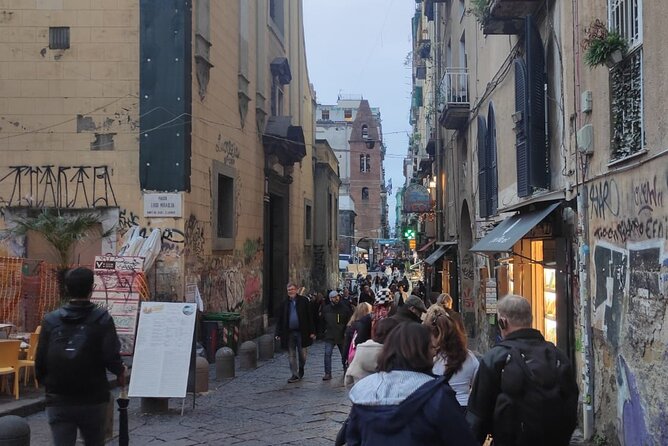
Here, Naples becomes loud, close, and wonderfully untidy. Historic businesses line the route, along with famous Neapolitan pizzerias, churches, and side streets. You will also see lanes leading away from the main road, each with its own small shops and local routines.
This is where a local guide can add the most value. A street like Via dei Tribunali is easy to walk through but harder to understand. The guide can connect the architecture, food traditions, religious life, and street layout in a way that makes the route feel less random.
The route is not designed as a pizza tasting tour, so do not book it expecting a full meal. You do receive one sweet or savory tasting, but the main focus is the city itself. If pizza is high on your Naples list, use the tour to identify places you might return to later.
The road can be busy, and the lanes are not always easy for a full group to navigate. Stay close to the guide, especially when the group reaches a side street. Headsets are supplied for groups of six or more, which should make explanations easier to follow when street noise rises.
Still Naples, but a slower afternoon:
- Naples: Naples Underground Entry Ticket and Guided Tour
★ 4.4 · 21,781 reviews - From Naples: Pompeii Ruins & Mount Vesuvius Day Tour
★ 4.3 · 11,459 reviews - From Naples: Sorrento, Positano and Amalfi Full-Day Tour
★ 4.6 · 10,988 reviews - From Naples: Sorrento, Positano & Amalfi Coast – Small Group Tour
★ 5.0 · 8,643 reviews
San Gregorio Armeno and the craft of the nativity scene
One of the most distinctive turns off Via dei Tribunali leads to Via San Gregorio Armeno, the famous street of nativity scenes.
This street is known for its presepi, the handcrafted figures and settings used in Neapolitan nativity displays. The tour allows about 15 minutes here. That is enough to see the character of the street and hear why it matters, though you will not have time to study every shop in detail.
San Gregorio Armeno adds a human scale to the historical story. Ancient walls can feel distant. Workshop windows, handmade figures, and narrow storefronts show that Naples’ traditions are still connected to everyday work.
This is also a good place to slow down mentally, even if the group keeps moving. Look into the shop windows and notice the mix of religious figures and local characters. The street is famous, so it can feel crowded at popular times. The guide helps you pass through it with some context instead of treating it as a quick photo stop.
If you want to buy a nativity figure, ask the guide for practical advice about where to browse. The tour itself does not promise shopping time, and the 15-minute schedule is fairly tight.
Spaccanapoli and the city’s straight line
The final major section is Spaccanapoli, the long street that cuts across the old city. Its name means Naples splitter, a reference to the way the road appears to divide the historic center.
Spaccanapoli is also called the Decumano Inferiore. It runs from the Quartieri Spagnoli toward Forcella, passing churches, apartment buildings, older facades, small bars, and the homes of local residents.
This is the part I would value most if you want to see Naples as a living city rather than a collection of monuments. The route passes through places where people shop, work, meet, and live. You get the grand churches, but you also get balconies, worn stone, street-level businesses, and the everyday rhythm of the old center.
The scheduled time is about 30 minutes. That makes Spaccanapoli the longest portion of the route, but it is still an introduction. You will not cover every branch of the street or explore the nearby Quartieri Spagnoli and Forcella in depth.
The lane can also be uneven and crowded. Wear comfortable shoes and keep your attention on the pavement as well as the buildings. This is an urban walk, not a gentle park stroll.
Ending at Piazza del Gesù Nuovo
The tour ends in Piazza del Gesù Nuovo, one of the key squares in Naples’ historic center. The square is framed by the Church of Gesù Nuovo, the Basilica of Santa Chiara, and restaurants.
This is a smart finishing point. You are left near major sights and places to eat, rather than being returned to the starting square. If you still have energy, you can continue exploring. If you are ready for dinner, the surrounding restaurants make the end point convenient.
The ending also gives the route a clear arc. You begin near Piazza Dante, pass through the old Greek and Roman street system, and finish among some of the center’s most important religious buildings.
The tour does not include admission to these churches. You are seeing them from the outside unless you choose to return later on your own. That is worth remembering if you want detailed interior visits.
Guides, headsets, and the human factor
The strongest praise is directed at the guides. Rosa is described as personal and thorough, while Ines is praised for combining history, folklore, and local customs. Giorgia and Georgia are both singled out for clear communication and attentive explanations. Giovanni received special appreciation for speaking slowly and patiently with a Korean-speaking couple who found English difficult.
These comments point to what you should want from this tour: not just dates and names, but help reading Naples as a place. A good guide can explain why a side street matters, point out details you would otherwise miss, and keep the history connected to daily life.
The guide’s style may not suit everyone. One low-rated account describes repeated explanations, strong personal opinions, and an insensitive comment about religion. That appears to be an exception among the feedback, but it is still useful to keep in mind. If a subject feels uncomfortable or unclear, ask a direct question and judge whether the guide responds respectfully.
Headsets are included when there are at least six participants. This is helpful on Via dei Tribunali and Spaccanapoli, where voices compete with traffic and street noise. The maximum group size is 20. That is not a private tour, but it is more manageable than a very large group.
Is $30.25 a fair price?
At $30.25 per person, the cost is reasonable for a two-hour guided walk in central Naples. You are paying for a local English-speaking guide, the route planning, headsets for larger groups, and one food tasting.
The price is strongest if this is your first time in Naples. A good orientation walk can save you from wandering past important sites without understanding them, and it can help you decide where to return for food or more sightseeing.
The value is lower if you already know the old center well or prefer to explore at your own pace. The tour does not include paid monument entry, a full meal, or extended time inside the churches. It is an introduction with interpretation, not a full-day cultural program.
A 4.9 rating from 200 reviews and a 99 percent recommendation rate suggest that the tour usually delivers what it promises. I would still choose it for the guide and street-level context, not because the price includes a long list of extras.
Who should book this walk?
I would recommend it to first-time visitors who want to understand the historic center before exploring it alone. It also suits anyone who enjoys food, local traditions, old streets, and stories about how a city developed.
Families may appreciate the short length, although adults should keep children close in narrow lanes. Most people can participate, and service animals are allowed. The experience requires walking through an active urban center, so you should be comfortable with uneven streets and a busy setting.
It is also a good choice for an afternoon arrival. The 4 p.m. start leaves the morning free and ends in a useful area for dinner. If you have only one day in Naples, this walk can give you a framework for the rest of your time.
You may want a different experience if you need wheelchair-specific route information, want extensive church interiors, or prefer a private guide. The supplied information says most people can participate, but it does not promise a fully step-free route.
Free cancellation is available if you cancel at least 24 hours before the 4 p.m. start. Changes or cancellations made later are not accepted for a refund. Poor weather or failure to meet the minimum group size can lead to a different date or a full refund.
Should you book the Naples Old Town walk?
Yes, if you want a well-paced first introduction to Naples’ historic center and prefer streets, stories, and local character over a checklist of indoor sights. The route covers a lot in two hours, from Greek fortifications to nativity workshops and Spaccanapoli’s lived-in city blocks.
Book it early if your schedule is fixed, since it is commonly reserved well ahead of the date. Choose it for the route and the guide, and keep your expectations realistic: you will get orientation, context, and one small tasting, not a complete tour of every monument. For $30.25, that is a sensible deal for finding your feet in Naples.
FAQ
Where does the walking tour begin?
The tour begins at Piazza Dante, P.za Dante, 80135 Napoli, Italy.
What time does the tour start?
The start time is 4 p.m.
Where does the tour end?
The tour ends in Piazza del Gesù Nuovo in Naples’ historic center.
How long is the walking tour?
The tour lasts approximately two hours.
Is the tour offered in English?
Yes. The experience is offered in English.
What food is included?
The tour includes one sweet or savory food tasting.
Are headsets provided?
Yes. Headsets are provided when the group has six or more participants.
What is the maximum group size?
The tour can have a maximum of 20 participants.
Is the tour suitable for most people?
Yes. Most people can participate, and service animals are allowed. The route is an urban walking tour through the historic center.
Can I cancel for a full refund?
Yes, if you cancel at least 24 hours before the experience start time. Late cancellations and changes are not refunded.
Recently added around Naples
- Naples: Traditional Neapolitan Music Concert★ 4.9 · 582 reviews
- Tramvia Napoli: Easy Drop-On Drop-Off Tour to Explore Naples★ 4.0 · 322 reviews
- Naples: Veiled Christ & Santa Chiara Cloister Small Group Tour★ 5.0 · 465 reviews
- Naples Street Food Tour: Discover Local Flavors with Expert Guide★ 5.0 · 428 reviews
- Small Group from Naples: Sorrento, Positano, Amalfi & Ravello★ 4.5 · 265 reviews
- Sorrento and Amalfi Coast Small Group Day Trip from Naples★ 4.5 · 659 reviews
- Form Naples, Premium Tour of Sorrento, Positano, Amalfi★ 5.0 · 186 reviews
- Naples Scenic E-Bike Ride to a Local Vineyard with Meal★ 5.0 · 288 reviews
Walking Tours, compared.

Guided Walking Tour & Last Supper Visit with Ticket
Read our review →


Rialto Bridge & Offbeat Unusual Venice Walking Tour
Read our review →

Private 3 hrs Venice Tour: St Mark’s, Walking tour & Boat tour
Read our review →

Skip the line: Uffizi and Accademia Small Group Walking Tour
Read our review →Browse the lists this tour appears in