
Reviewed · LECCE TOURS
Discovering Lecce
Lecce turns stone into theater. This two-hour walking tour gives you a clear introduction to the city’s Baroque center, with local guide Lorenzo bringing art, politics, religion, and Roman archaeology into the same easy-paced walk. I especially like the small group limit of 15 people and the way the route links major sights instead of treating them as isolated monuments. The price, $35.09 per person, is also fair for a guided introduction, though entrance fees are not included and the main churches are viewed from outside.
The tour is a good fit if you want orientation before exploring Lecce on your own. Lorenzo is repeatedly praised for his humor, strong English, local roots, and ability to explain complicated architecture in plain terms. The main limitation is that the tour lasts about two hours, so you get context and exterior views rather than a full museum or church visit.
In This Review
- Key Points to Know Before You Book
- Why This Short Tour Works in Lecce
- Meeting at the Accademia di Belle Arti
- Piazza del Duomo and Lecce’s Baroque Stage
- The Roman Theater Beneath the Baroque City
- Piazza Sant’Oronzo and Four Layers of City Life
- Santa Croce and the Big Baroque Finish
- Lorenzo’s Guiding Style
- The Coffee Break and the Pace
- What the $35.09 Price Gets You
- Who Should Choose This Lecce Walk?
- FAQ
- How long does the Discovering Lecce tour last?
- What language is the tour offered in?
- What sights are included?
- Are entrance tickets included?
- Is coffee or tea included?
- Where does the tour begin and end?
- What is the cancellation policy?
- Should You Book It?
Key Points to Know Before You Book
- Lorenzo gives the tour a local voice: He is from Lecce and mixes art history with personal enthusiasm, humor, and practical suggestions.
- The route covers four major sights: You visit Piazza del Duomo, the Roman Theater, Piazza Sant’Oronzo, and the Basilica of Santa Croce.
- The focus is Baroque Lecce: You learn how local limestone, Catholic symbolism, and political power shaped the city’s ornate façades.
- The walking pace is relaxed: The planned stops add up to about 75 minutes, leaving room for movement, explanations, and a coffee or tea break.
- The group stays fairly small: A maximum of 15 people makes it easier to hear the guide and ask questions.
- Church and museum entry costs extra: The listed stops are mainly outside visits, so plan a separate visit if you want to see the interiors.
Why This Short Tour Works in Lecce
Lecce can feel confusing at first. Its old center is compact, but the streets twist around churches, Roman remains, noble palaces, and pale-gold Baroque façades. Without some background, it is easy to admire the decoration without understanding why the city looks this way.
This tour gives you that background quickly. It connects the city’s Roman past with its later religious and civic buildings, showing how different periods share the same streets. You are not simply ticking off four squares and monuments. You are learning how Lecce developed and why its architecture is so distinctive.
I like the route because it balances big sights with explanation. Piazza del Duomo gives you the grand Baroque setting. The Roman Theater adds an earlier layer. Piazza Sant’Oronzo brings together Roman, Venetian, Baroque, Art Nouveau, and Rationalist influences. Santa Croce ends the walk with Lecce’s most extravagant church façade.
The tour is offered in English and uses a mobile ticket. Confirmation arrives when you book, and the group can include up to 15 people. That size is small enough for a personal feel, though it is not the same as hiring a private guide.
A few more Lecce bookings to compare
- Lecce: Baroque Architecture and Underground Walking Tour
★ 4.7 · 842 reviews - Small group tour of the caves of Santa Maria di Leuca
★ 5.0 · 806 reviews - 3 Hour Group Tour by Boat to the Caves of Santa Maria di Leuca
★ 5.0 · 472 reviews
Meeting at the Accademia di Belle Arti
The walk begins at the Accademia di Belle Arti di Lecce on Via Giuseppe Libertini, 3. This gives you a central starting point in the historic city, but you should check the exact meeting location before setting off so you do not waste time searching among the old streets.
The tour finishes at the Basilica of Santa Croce on Via Umberto I, 1. That is useful planning information. You do not return to the starting point, so you can continue exploring the center from Santa Croce, stop for lunch, or arrange another activity nearby.
Lecce’s old streets are suited to walking, and the tour does not include transportation. Wear shoes you can use comfortably for two hours. The experience requires good weather, so a rainy-day plan matters. If poor weather cancels the tour, you can receive a full refund or choose another date.
Piazza del Duomo and Lecce’s Baroque Stage
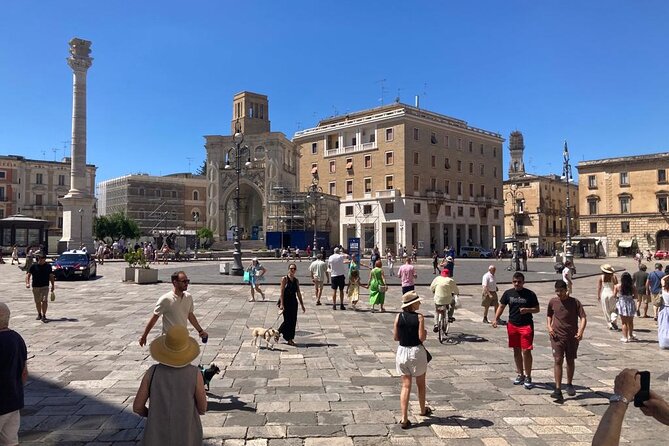
The first major stop is Piazza del Duomo, one of Lecce’s most carefully composed spaces. The square opens like a theater, with buildings arranged around you rather than simply lining a street. It is a strong place to begin because the architecture feels grand but still easy to read as a group.
Look first at the bell tower on the left. Built in the late 17th century by Giuseppe Zimbalo, it rises above the square with a majolica dome. Its height gives the space a vertical center and helps you understand how churches used towers to announce civic and religious authority.
The cathedral occupies the center. Its façade includes a balustrade, flowers, angels, and sharp lance-shaped details, along with a statue of Sant’Oronzo, Lecce’s protector. The decoration is busy by design. Lorenzo’s art background is particularly useful here because he can help you separate symbolic details from pure ornament.
The Episcopio, with its portico-like entrance, fills another side of the square. Emanuele Manieri designed this part, while the Palazzo del Seminario brings a different surface treatment, including rustication and an eclectic Baroque style associated with Giuseppe Cino.
You view the buildings from outside, and no admission ticket is included. That is not a problem for a first look, but it does mean you should allow extra time later if you want to enter the cathedral or other religious buildings. The value of this stop is the explanation of the whole composition. On your own, you might see an ornate square. With guidance, you can read it as a planned display of faith, power, and local craftsmanship.
The Roman Theater Beneath the Baroque City
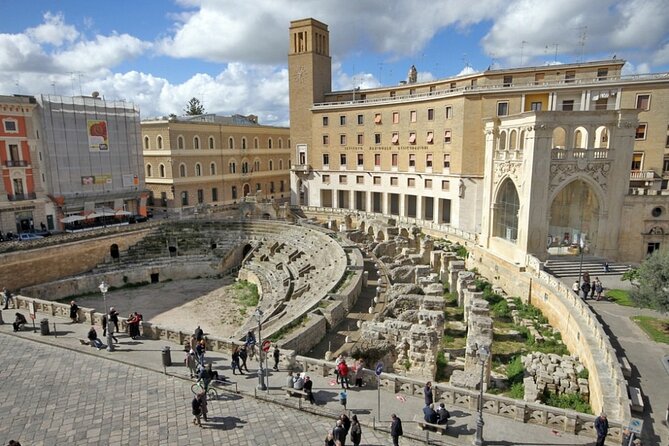
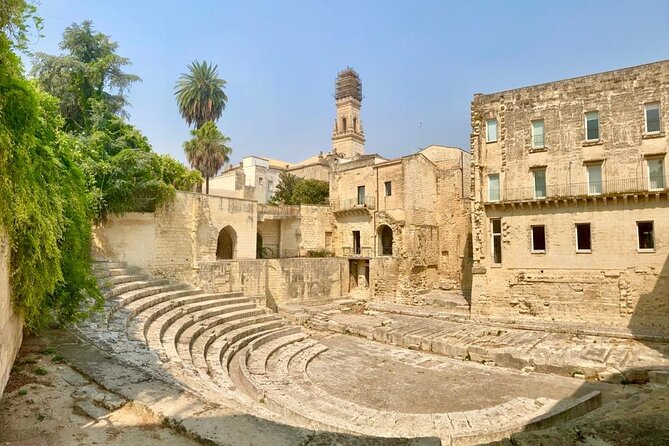
The Roman Theater offers a sharp change of mood. Instead of looking upward at elaborate façades, you look down into an ancient performance space from the Augustan age. The theater was buried for centuries and revealed through excavation in the 19th century.
The remains include the orchestra, proscenium, terraces, and open areas framed by Baroque gardens. That setting is part of the appeal. Roman stonework sits within a later city, and the gardens soften the archaeological site without hiding its form.
This is an outside viewing stop lasting about 15 minutes. Admission is not included. The short visit works well in the flow of the tour because it gives you a physical sense of Lecce before the city became a center of ornate southern Italian Baroque.
This stop may feel brief if ancient Rome is your main interest. The tour does not promise a detailed archaeological visit or access to every part of the theater. I see it instead as a useful historical marker, one that prevents Lecce from becoming only a parade of churches and decorative stone.
Still Lecce, but a slower afternoon:
- Snorkelling-Tour in Porto Cesareo with typical aperitif
★ 5.0 · 452 reviews - Lecce: Pasta Making Class in 1400s-Era Courtyard with Wine
★ 4.7 · 369 reviews - Lecce: City Highlights Guided Tour by Bike
★ 4.8 · 362 reviews - Tour to 4 Towns of Salento: Otranto, Leuca, Gallipoli, Galatina
★ 5.0 · 360 reviews
Piazza Sant’Oronzo and Four Layers of City Life
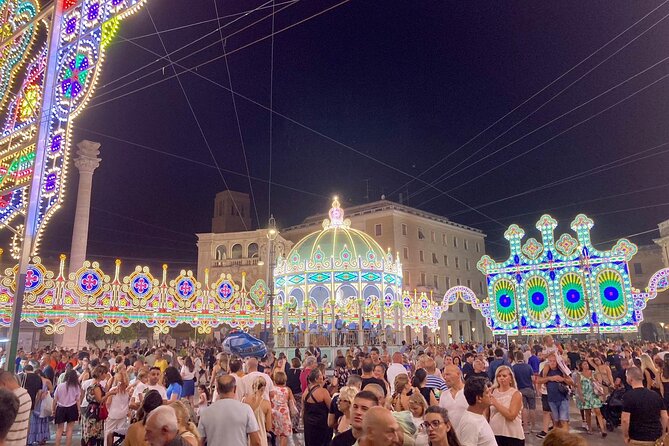
Piazza Sant’Oronzo is the city’s central meeting place and one of the most revealing stops on the walk. It was once known as Piazza dei Mercadanti, or the Merchants’ Square, and still carries signs of different periods.
The Palazzo del Sedile once served as a place for exhibitions and city assemblies. Beside it is the Church of Saint Mark, a reminder of the influence of the Maritime Republic of Venice. That Venetian connection adds another thread to Lecce’s story, showing that the city’s character was shaped by contacts beyond its immediate region.
The square also borders the ancient Roman Amphitheater, only partly revealed. Its exposed curve sits among buildings from very different eras, including Baroque, Art Nouveau, Rationalist, and Venetian examples. This mixture is one reason I find the stop so useful. You can see the city’s changes in one compact view instead of studying each period separately.
There is no admission charge for the square itself. The amphitheater is viewed as part of the public space, while the tour remains focused on outdoor interpretation. If you want a long archaeological discussion, this will feel like an introduction. If you want to understand how old and new Lecce overlap, it is one of the strongest parts of the route.
Santa Croce and the Big Baroque Finish
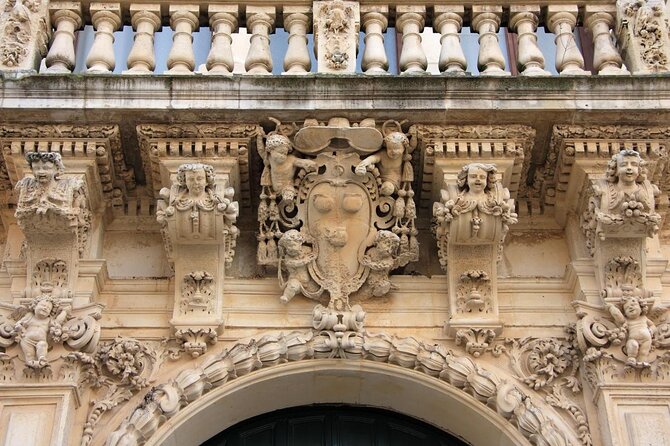
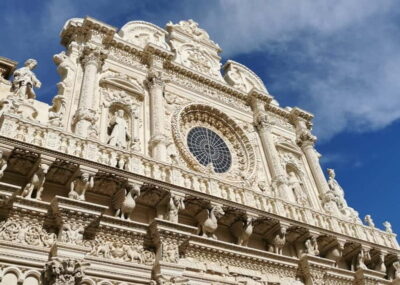
The Basilica di Santa Croce is the final stop and the visual climax of the walk. Its façade is filled with symbols, figures, columns, and carved details. It can be hard to know where to look first, which is exactly why a guide helps.
The church façade is connected with the Battle of Lepanto and presents a strong statement about Christian and Western European identity. Lorenzo explains the religious ideas behind the decoration, along with the way Baroque artists used movement, contrast, and symbols to guide the eye.
This is another outside visit, and entry is not included. That distinction matters because Santa Croce is the sort of building many people will want to enter after seeing the façade. The tour gives you the tools to understand what you are looking at, but you will need to pay separately if you continue inside.
Ending here is practical as well as dramatic. The basilica is in a central area, so you can carry on with your own sightseeing. You may also want to return at a quieter time, since the two-hour visit gives you only a first reading of the exterior.
Lorenzo’s Guiding Style
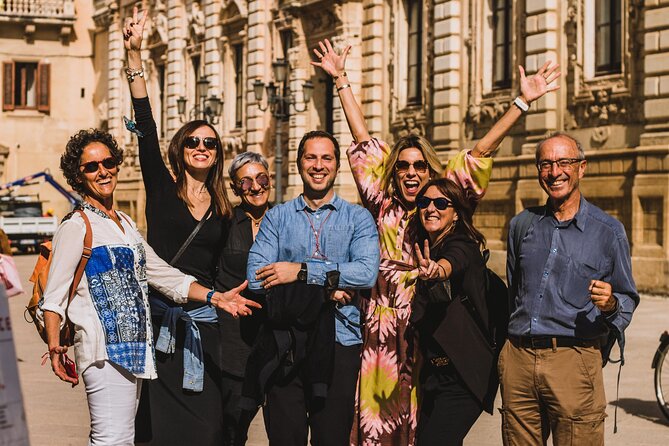
The guide is the strongest reason to choose this experience. Lorenzo is described as animated, friendly, funny, and passionate about his home city. He has a background in art, and that helps when the tour shifts from dates and names to the meaning behind Baroque decoration.
His style appears relaxed rather than formal. He explains history in a way that is easy to follow, adds quirky humor, and takes time to speak with people in the group. That personal approach matters on a walking tour because Lecce’s architecture can quickly become a blur of similar pale stone and elaborate carving.
You should also expect practical advice along with history. Lorenzo is praised for helping with recommendations after the walk, which is useful if Lecce is one stop on a larger Puglia trip. His local perspective gives the tour more character than a memorized list of dates.
English is offered, and the feedback about his English is strong. Still, every guide has a personal rhythm, and explanations of art and religion can involve specialized terms. If you prefer a very quiet tour with little humor, his lively delivery may not be your style. For most people, though, the energy keeps the two hours moving.
The Coffee Break and the Pace
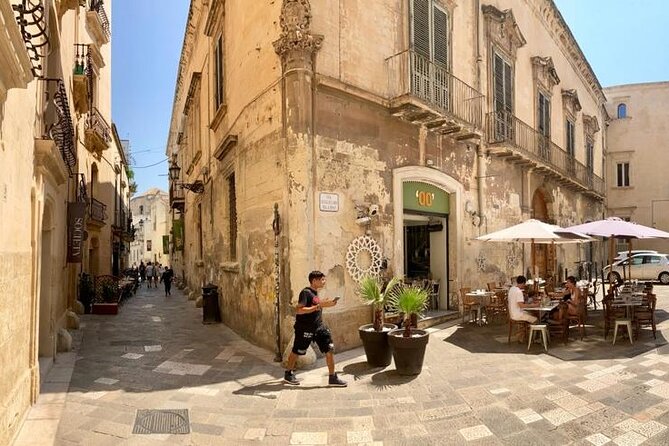
Coffee and tea are included. A stop at 00 Doppiozero has also included cake and iced sweet almond coffee, known locally as caffè Leccese. Since the exact refreshment may depend on the day, it is best to treat the break as a welcome part of the experience rather than the main reason to book.
The pause adds a local touch and gives you a chance to absorb the information. Two hours of architecture and church symbolism can be a lot, especially in warm weather. A drink and small snack make the walk feel less like a lecture and more like an outing through the city.
The listed stops account for roughly 20 minutes at Piazza del Duomo, 15 minutes at the Roman Theater, 20 minutes at Piazza Sant’Oronzo, and 20 minutes at Santa Croce. The remaining time allows for walking, transitions, and the refreshment stop. The pace is described as easy, but you are still on your feet for much of the experience.
What the $35.09 Price Gets You
At $35.09 per person, this is a reasonable price for a two-hour guided orientation, especially with a local guide who can explain Lecce’s art and history in English. The coffee or tea adds a modest practical benefit, and the group cap keeps the experience from becoming a large procession.
The price does not cover church or museum entrance. That can be a benefit if you want to choose your own interiors later, since you are not paying for admission to places you may not enter. It is a drawback if you expect a fully guided indoor tour of the cathedral or Basilica di Santa Croce.
The real value is the time saved. You can walk through Lecce alone for free, but you may miss the connection between Roman remains, Venetian influence, Catholic symbolism, and the city’s Baroque building boom. This tour gives you a framework for the rest of your visit, then lets you decide which places deserve a return visit.
The tour is often booked well ahead, with an average booking time of 49 days in advance. That suggests you should not leave it until the last moment if your dates are fixed. Free cancellation is available until 24 hours before the start time, while cancellations or changes made later are not refunded.
Who Should Choose This Lecce Walk?
I would choose this tour if you are visiting Lecce for the first time and want a sensible introduction without giving up half a day. It suits people who enjoy architecture, religious art, local stories, and a guide who can connect details to the wider city.
It is also a good choice for visitors who prefer a small group but do not need a private tour. Families and older visitors may appreciate the relaxed pace, and most people can participate. Service animals are allowed.
You may want something else if your priority is interior access, archaeology, or a long specialist lecture. The tour stays outside at the listed monuments and gives each place a limited amount of time. Think of it as a foundation for independent exploring, not a complete study of Lecce.
FAQ
How long does the Discovering Lecce tour last?
The tour lasts approximately two hours.
What language is the tour offered in?
The tour is offered in English.
What sights are included?
The route includes Piazza del Duomo, the Roman Theater of Lecce, Piazza Sant’Oronzo, and the Basilica di Santa Croce.
Are entrance tickets included?
No. Entrance tickets to churches and museums are not included, and the cathedral, Roman Theater, and Basilica are listed as outside visits.
Is coffee or tea included?
Yes. Coffee and/or tea are included. A stop at 00 Doppiozero has also included cake and iced sweet almond coffee.
Where does the tour begin and end?
The tour begins at the Accademia di Belle Arti di Lecce, Via Giuseppe Libertini, 3. It ends at the Basilica of the Holy Cross, Via Umberto I, 1.
What is the cancellation policy?
You can cancel at least 24 hours before the start time for a full refund. Poor weather or failure to meet the minimum number of participants may lead to a different date or a full refund.
Should You Book It?
Book this tour if you want to get your bearings fast and understand why Lecce is famous for Baroque architecture. Lorenzo’s local knowledge, art background, humor, and personal attention give the walk its value, while the route covers the city’s most important central sights without rushing.
Skip it only if you already know Lecce well or want extensive interior visits. For a first look, the $35.09 cost is fair, the two-hour length is manageable, and the final stop at Santa Croce leaves you in a good position to continue exploring on your own.
Recently added around Lecce
- Lecce: Pasta Making Class in 1400s-Era Courtyard with Wine★ 4.7 · 369 reviews
- Tour of Lecce with a visit to the basement of the ancient synagogue★ 5.0 · 258 reviews
- Orecchiette Cooking Class and Wine Pairing in Lecce★ 4.5 · 205 reviews
- Ostuni, Alberobello and Polignano a Mare. Departing from Lecce★ 5.0 · 195 reviews
- Mini-cruise tour to the Caves of Santa Maria di Leuca★ 5.0 · 250 reviews
- Cooking class, dinner and wine tasting near Lecce★ 5.0 · 350 reviews
- Lecce History and Street Food Tasting Small Group Tour★ 5.0 · 288 reviews
- Tour to 4 Towns of Salento: Otranto, Leuca, Gallipoli, Galatina★ 5.0 · 360 reviews
Lecce Tours, compared.
Baroque Architecture and Underground Walking Tour
Read our review →
Small group tour of the caves of Santa Maria di Leuca
Read our review →
3 Hour Group Tour by Boat to the Caves of Santa Maria di Leuca
Read our review →Snorkelling-Tour in Porto Cesareo with typical aperitif
Read our review →
Pasta Making Class in 1400s-Era Courtyard with Wine
Read our review →
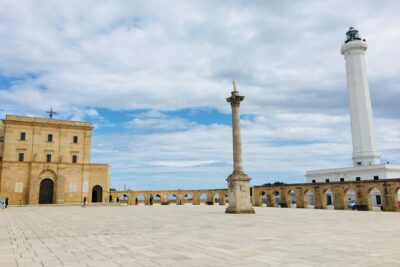
Tour to 4 Towns of Salento: Otranto, Leuca, Gallipoli, Galatina
Read our review →
Cooking class, dinner and wine tasting near Lecce
Read our review →Browse the lists this tour appears in