
Reviewed · 1-HOUR EXPERIENCES
Pisa: Beyond the Tower (1h round-trip tour)
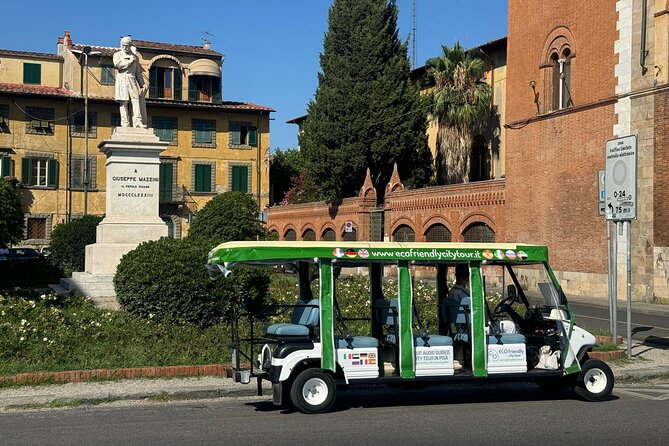
Pisa has more than one famous angle. This one-hour round-trip tour uses a compact golf cart to show you Pisa beyond the Leaning Tower, with stops for Medici palaces, Arno River views, Gothic architecture, modern murals, and stories tied to Galileo and the Shelleys. I especially like the small group of no more than six people and the way the route reaches both sides of the river without asking you to march across town.
I also like the lively local guiding. Guides such as Aloisa have been praised for clear English, good humor, safe driving, and a willingness to stop for photographs or answer questions. The main drawback is the tight schedule: with about five minutes at each of eleven stops, you see a great deal, but you will not have time for a full museum visit or a long look inside most buildings. In a few cases, passengers have also found it hard to hear the guide from the cart.
In This Review
- Key points at a glance
- Why this short Pisa tour works
- Starting near the cathedral quarter
- Domus Galilaeana and Pisa’s scientific side
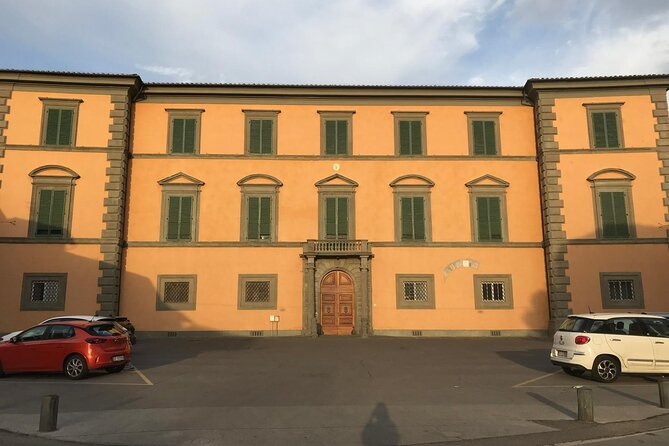
- Palazzo Reale and the Medici presence
- Palazzo Blu and a quick art stop
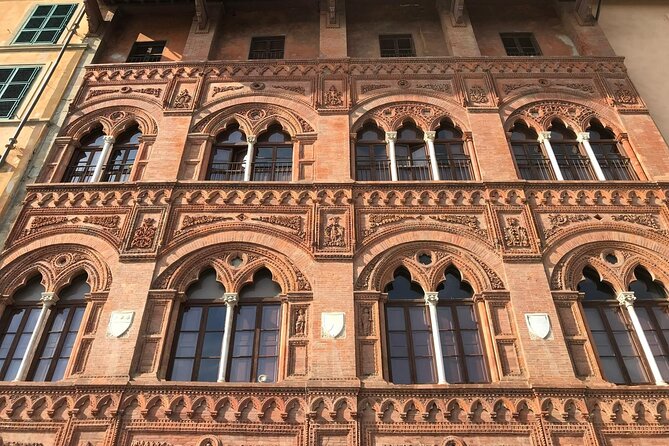
- Palazzo Agostini proves the tower is not alone
- Ponte di Mezzo and the center of Pisa
- Medici power on the opposite bank
- Palazzo Chiesa and the Shelley connection
- Keith Haring’s Tuttomondo mural
- Galileo Galilei by Eduardo Kobra
- Santa Maria della Spina beside the Arno
- Piazza dei Cavalieri and Dante’s tragic story
- What the one-hour timing really means
- Comfort, weather, and the small-group advantage
- Who should book it?
- Should you book Pisa: Beyond the Tower?
- FAQ
- How long is Pisa: Beyond the Tower?
- Where does the tour start and finish?
- Is the tour offered in English?
- How many people can join the tour?
- Is admission included?
- What happens if bad weather cancels the tour?
Key points at a glance
- Eleven stops in about one hour: The route packs in Pisa’s major square, palaces, churches, murals, and river crossings.
- A compact group: With a maximum of six people, the ride feels more personal than a large city tour.
- A useful break from walking: The golf cart helps in hot weather, during rain, or when you are traveling with children or someone who tires easily.
- More than the Leaning Tower: You see Keith Haring’s Tuttomondo mural, the Galileo Galilei mural, Palazzo Blu, and the south bank of the Arno.
- English-speaking local guide: The best guides add stories about Pisa’s people, buildings, soil, politics, art, and annual traditions.
- A weather-sensitive outing: Poor weather can lead to a changed date or a full refund, so keep that policy in mind when planning a short visit.
Why this short Pisa tour works
Most people arrive in Pisa with one task: get the photograph of the Leaning Tower, perhaps admire the cathedral, then move on. That plan is understandable, but it reduces a complicated old city to one tilted monument.
This tour gives you a quick corrective. You still begin near the celebrated Piazza dei Miracoli area, but then the route moves into central Pisa and across the Arno. You see grand ducal buildings, a small Gothic church, an old bridge, a former Shelley residence, and some striking modern public art.
The format matters. You ride rather than walk, so you can cover more ground in an hour. That makes the experience useful for a short stop between trains, a cruise excursion, or a first look before exploring on foot.
The price is $36.30 per person. That is not the cheapest way to see Pisa, especially if you already plan to walk around the center. Still, the value improves if you have limited time, do not want to navigate the city yourself, or appreciate a local guide who can connect scattered sights into one story.
The overall rating is 4.9 from 238 ratings, with 97 percent recommending it. Those figures point to a consistently strong experience, though the lower-scoring feedback gives you one important warning: a moving golf cart can make hearing difficult. Sit close to the guide, ask for repetition when needed, and do not expect a quiet museum-style talk.
A few more Pisa bookings to compare
- Reserved Entrance to Leaning Tower of Pisa & Cathedral
★ 4.5 · 10,391 reviews - Pisa: Leaning Tower & Cathedral Tickets with Timed Entry
★ 4.3 · 2,365 reviews - Pisa: Baptistery and Cathedral Tour & Leaning Tower Option
★ 4.8 · 1,191 reviews
Starting near the cathedral quarter
The meeting point is Piazza Arcivescovado, at 56126 Pisa. From there, the route begins close to Pisa’s most famous sights, but the purpose is not simply to linger beside the tower.
That is a sensible starting point. You begin with an easy sense of place, then move into the wider city. The tour ends back at the same meeting point, which is helpful if you have left luggage nearby or want to continue visiting the cathedral complex afterward.
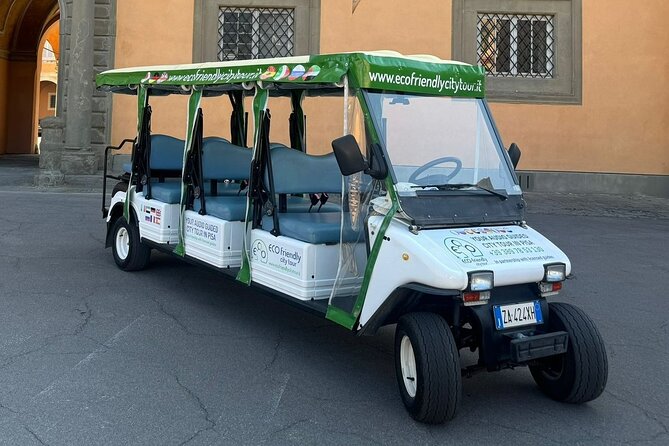
The ride is described in passenger feedback as a golf cart tour. It is a practical choice for Pisa’s narrow urban streets and gives you a raised view compared with walking through a crowd. The small vehicle also lets the guide speak directly to the group, though road noise may sometimes compete with the commentary.
Domus Galilaeana and Pisa’s scientific side
The first stop is Domus Galilaeana, described as Tuscany’s first public observatory. Admission is included, and the planned stop lasts about five minutes.
That short visit is best treated as an introduction rather than a full museum experience. The building gives the tour a useful change of direction: Pisa is not only medieval stone and Renaissance power. It also has a strong connection to scientific study and Galileo Galilei.
If you are fascinated by science, this stop may leave you wanting more time. The tour’s strength is the wider picture, not extended time at one institution. Listen for the guide’s explanation, take in the setting, and note the place for a longer visit if your schedule allows.
Palazzo Reale and the Medici presence
The Museo Nazionale di Palazzo Reale was once a residence of Tuscany’s grand dukes. The tour pauses here for roughly five minutes, with admission free.
This stop helps explain the political weight of Pisa. The city was not just a port or university center. Powerful rulers also wanted a foothold here, and the palace reflects that connection to the Medici world.
You will not have time to tour the museum in an hour-long circuit. Instead, you get the outside context and a quick explanation of why the building matters. That is useful if you want to return later with more time, but less satisfying if your main aim is to view museum collections.
Still Pisa, but a slower afternoon:
- From Rome: Discover Florence & Pisa in a Full-Day Trip
★ 4.3 · 1,090 reviews - Pisa: Cathedral Guided Tour & Optional Leaning Tower Ticket
★ 4.7 · 1,036 reviews - Pisa: Square of Miracles Monuments Ticket with Leaning Tower
★ 4.6 · 944 reviews - Pisa: Half-Day Afternoon Tour from Florence
★ 4.5 · 822 reviews
Palazzo Blu and a quick art stop
Palazzo Blu is an art museum named for the blue color of its façade. Admission is included, and the planned stop is about five minutes.
The building offers an easy visual marker along the route. Its color makes it memorable, and its role as an art museum adds another layer to the city beyond churches and towers.
Again, five minutes will not permit a proper museum visit. Think of this as a preview and orientation stop. The guide can tell you why it belongs on your Pisa list, while the cart keeps the larger route moving.
Palazzo Agostini proves the tower is not alone
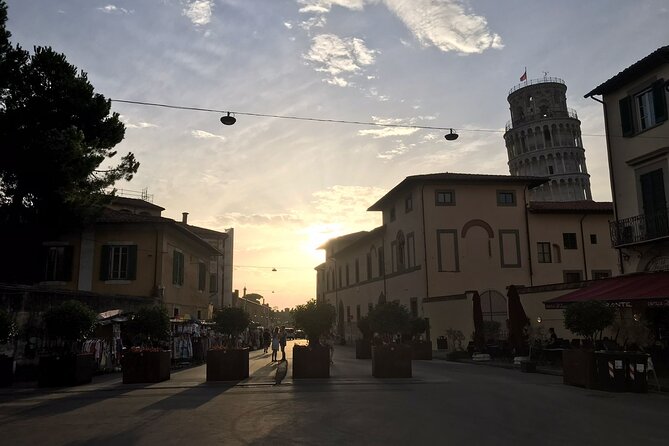
At Palazzo Agostini, the guide points out another leaning structure. This is one of the more engaging details on the route because it challenges the idea that Pisa’s famous tilt is a one-off curiosity.
The soft ground near the river and sea has affected several buildings in the city, according to the commentary described by passengers. That bit of context makes the Leaning Tower more understandable. Its angle is not just a strange architectural accident. It is part of a wider local story about foundations and soil.
The stop is brief, but it gives you a fact worth repeating later. Pisa’s tilted buildings are a citywide conversation, not merely a queue at one monument.
Ponte di Mezzo and the center of Pisa
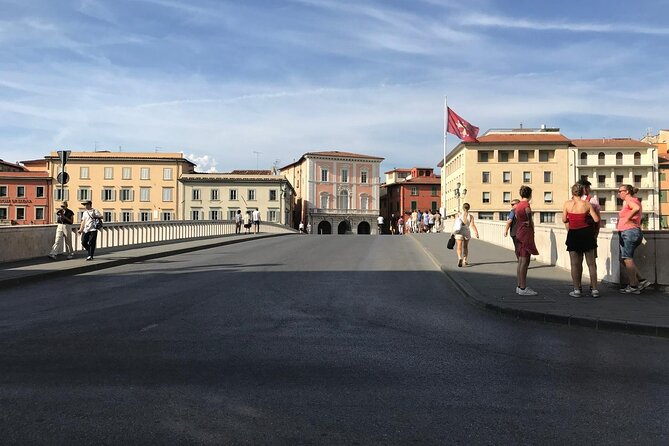
Ponte di Mezzo crosses the Arno and takes its name from its position in the middle of the city. It has both geographic and historic importance.
This is a good point in the route to understand Pisa as a city divided and joined by its river. The bridge connects the two sides, and the tour uses that crossing to shift from the area most people know toward the old town on the south bank.
The bridge stop also offers a chance to appreciate the city’s layout without studying a map. You see how the river shapes the center and why the two banks have their own identities.
Medici power on the opposite bank
Palazzo Vecchio de’ Medici sits on the Medici side of the Arno. Today, it serves as the seat of the prefecture. The building is also positioned opposite the ruins of Palazzo Chiesa, creating a useful contrast between political authority and literary memory.
The Medici connection runs through several stops, and the guide can tie these places together into one story. That is where a local escort adds real value. A building can look like another elegant palace until someone explains who used it and why it mattered.
You will only have a short exterior visit. If you want detailed architectural study, plan to walk back later. For a fast survey, however, the location gives you a clear sense of Pisa’s civic and ruling past.
Palazzo Chiesa and the Shelley connection
Palazzo Chiesa now survives as ruins after destruction during World War II. It was once the residence of Percy Shelley and Mary Shelley, and a plaque keeps their connection to Pisa alive.
This is a particularly nice stop for readers of English literature. Percy Shelley, the poet, and Mary Shelley, the novelist best known for Frankenstein, briefly lived here. The ruined site also shows how war can erase a building while leaving its cultural memory behind.
The stop is free and lasts about five minutes. Do not expect a preserved interior or a grand literary house. The appeal is the plaque, the story, and the chance to connect Pisa with two major English writers.
Keith Haring’s Tuttomondo mural
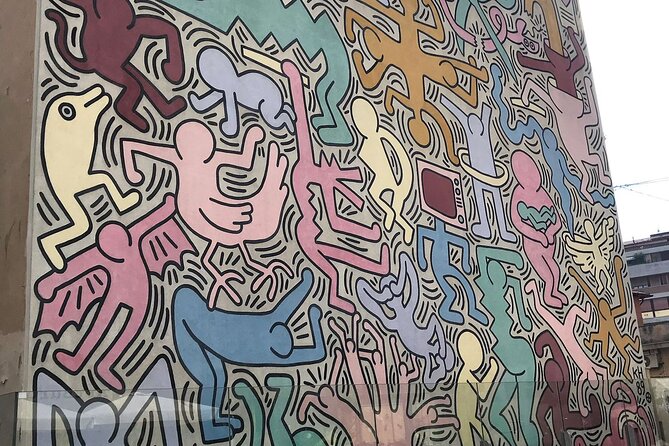
Tuttomondo, painted by Keith Haring, is one of the few outdoor works he created for permanent public display. Its subject is peace and harmony.
This is one of the route’s strongest stops because it breaks up the old-palace rhythm with bold modern color and public art. You see a different Pisa here, one that is open to contemporary ideas as well as proud of its medieval and Renaissance past.
The mural is also a useful photo stop. Several passengers valued the chance to see Pisa’s murals, and guides have been willing to pause for photographs when the group requested it. The five-minute timing should be enough to view the work and hear its basic story, though art lovers may want to return on foot.
Galileo Galilei by Eduardo Kobra
A newer addition to Pisa’s public art is Eduardo Kobra’s Galileo Galilei mural. It shows the famous physicist looking through a telescope shaped like the Leaning Tower.
The design neatly joins two Pisa symbols: Galileo and the tilted monument. After visiting Domus Galilaeana, this mural feels like a visual echo of the tour’s scientific theme.
Because the work is recent, it also shows that Pisa’s story is still being retold. The city is not frozen in the past. Contemporary artists continue to use its famous figures and buildings in fresh ways.
Santa Maria della Spina beside the Arno
Chiesa di Santa Maria della Spina is a small Gothic church on the riverbank. Its size makes it easy to miss if you are focused only on the Leaning Tower, yet its position and exterior detail make it one of the route’s most attractive quick stops.
The church is best enjoyed from outside during this tour. Five minutes gives you time to see the setting and hear the guide’s explanation, but not time for a slow architectural inspection.
I like this stop because it makes the river feel more than a route between attractions. The Arno is part of Pisa’s visual character, and Santa Maria della Spina gives the waterfront a graceful focal point.
Piazza dei Cavalieri and Dante’s tragic story
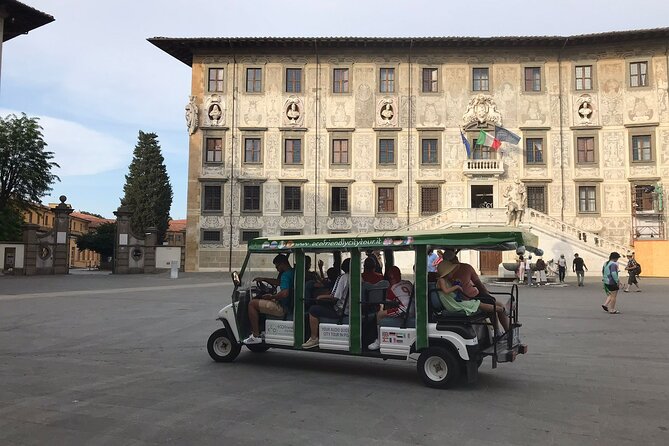
The final listed stop is Piazza dei Cavalieri, once the center of Pisa’s political life. It is now home to the prestigious Scuola Normale Superiore di Pisa, an institution for higher education.
The square is often considered Pisa’s second major civic space after Piazza dei Miracoli. Its connection to Count Ugolino della Gherardesca adds a darker note. Ugolino met his end in the tower located here in 1289, and Dante later made the episode famous in Canto 33 of Inferno.
This is the kind of story that can make a short stop stick in your mind. The square is not only a beautiful architectural setting. It is also a place where politics, education, medieval conflict, and literature meet.
What the one-hour timing really means
The route includes eleven stops, each planned for about five minutes. That is a lot of ground in a short period, and the timing explains both the tour’s appeal and its limits.
You get a broad city introduction rather than a series of full visits. You will see façades, plaques, public art, river views, and important squares. You will not have time to linger in each museum, read every inscription, or explore every church interior.
I would use this tour at the beginning of a Pisa visit. It helps you decide where to return on foot. If you have only one hour in town, it offers more range than walking directly to the tower and back.
The guide’s pace matters. Aloisa has been praised for packing art, architecture, history, and local stories into the hour while remaining friendly and safe behind the wheel. Other guides have also been described as polite, enthusiastic, and clear in English.
Comfort, weather, and the small-group advantage
The golf cart is particularly useful in hot weather, and it gives your legs a break. A family with three young children found it an easy way to see more of Pisa, and one guide accommodated a mother’s wheelchair while also being considerate of a father who was hard of hearing.
That does not guarantee every seating or accessibility need can be met, so contact the operator if your requirements are specific. The official information says most people can participate, service animals are allowed, and the activity is near public transportation.
Rain is a more complicated issue. One group stayed dry and enjoyed the tour during rain, but the activity also requires good weather and may be canceled in poor conditions. If the operator cancels, you are offered another date or a full refund. Keep a backup plan if this is your only chance to see Pisa.
The maximum group size is six. That is small enough for direct questions and photo requests, and far less cumbersome than a large coach. It also means the experience depends heavily on the guide and on how well the group can hear from the moving cart.
Who should book it?
I would choose this tour if you want a fast orientation, dislike long walks, or have already seen the Leaning Tower and want a broader look at Pisa. It is also a good fit for families, older adults, and anyone with only a short window in the city.
Art lovers will appreciate the two murals and Palazzo Blu. History fans get the Medici palaces, Piazza dei Cavalieri, the Shelleys, Galileo, and the effects of the city’s soft ground. Photographers get repeated chances to request brief stops.
I would skip it if you want deep museum time, a slow architectural tour, or complete control over every stop. At $36.30, the cost is fair for the small group, transport, guide, and wide route, but it is less attractive if you are happy to walk and research the same sights yourself.
Book at least a day ahead, and preferably earlier if your schedule is fixed. The experience is often reserved about 20 days in advance. Cancel at least 24 hours before the start time for a full refund, since later cancellations and changes are not accepted.
Should you book Pisa: Beyond the Tower?
Yes, if you want Pisa to become a city rather than a single photograph. The one-hour golf cart ride gives you an efficient route, a local voice, and several sights you might otherwise miss, especially on the south side of the Arno.
Go in with the right expectation: this is a lively overview, not eleven full museum visits. Sit close to the guide, keep your camera ready, and use the tour to mark places for a later walk. For a short stay, the mix of Galileo, the Medici, the Shelleys, Haring, Kobra, and the Arno makes the $36.30 price worthwhile.
FAQ
How long is Pisa: Beyond the Tower?
The tour lasts approximately one hour and returns to the starting point.
Where does the tour start and finish?
It starts at Piazza Arcivescovado, 56126 Pisa PI, Italy, and ends back at the same meeting point.
Is the tour offered in English?
Yes. The experience includes a live English-speaking guide.
How many people can join the tour?
The activity has a maximum of six participants.
Is admission included?
Admission is included for Domus Galilaeana, Palazzo Blu, Ponte di Mezzo, Palazzo Vecchio de’ Medici, and Piazza dei Cavalieri. Admission is listed as free at Museo Nazionale di Palazzo Reale, Palazzo Agostini, Palazzo Chiesa, Tuttomondo, Galileo Galilei by Eduardo Kobra, and Chiesa di Santa Maria della Spina.
What happens if bad weather cancels the tour?
If poor weather causes a cancellation, you will be offered a different date or a full refund. You can also cancel at least 24 hours before the start time for a full refund.
Recently added around Pisa
- Pisa’s Ultimate Food Tour: Full Tuscan Meal by Do Eat Better★ 5.0 · 263 reviews
- Pisa all inclusive: Baptistery, Cathedral and Leaning Tower guided tour★ 4.5 · 473 reviews
- Leaning Tower and Cathedral of Pisa afternoon timed-entry Ticket★ 3.5 · 173 reviews
- PRIVATE tour in Carrara marble quarries with 4×4 vehicles★ 4.5 · 233 reviews
- Best of Pisa: Small Group Tour with Admission Tickets★ 4.5 · 267 reviews
- Timed Entrance to Leaning Tower Pisa & Cathedral with Audio★ 4.1 · 385 reviews
- Pisa: Square of Miracles Monuments Ticket with Leaning Tower★ 4.6 · 944 reviews
- Pisa Leaning Tower & Cathedral Official Ticket★ 3.9 · 185 reviews
1-Hour Experiences, compared.
Private Cruise on Lake Como with Speedboat from 1H to 4H
Read our review →
Private Guided Tour by Speedboat on Lake Como from 1H to 4H
Read our review →
From 1H to 4H License Free Boat Rental 40cv Lake Como
Read our review →
1-Hour Private Photo Shoot for Family, Couples or Solo
Read our review →
David & Accademia Gallery: 1-Hour Small Group Tour
Read our review →Browse the lists this tour appears in